
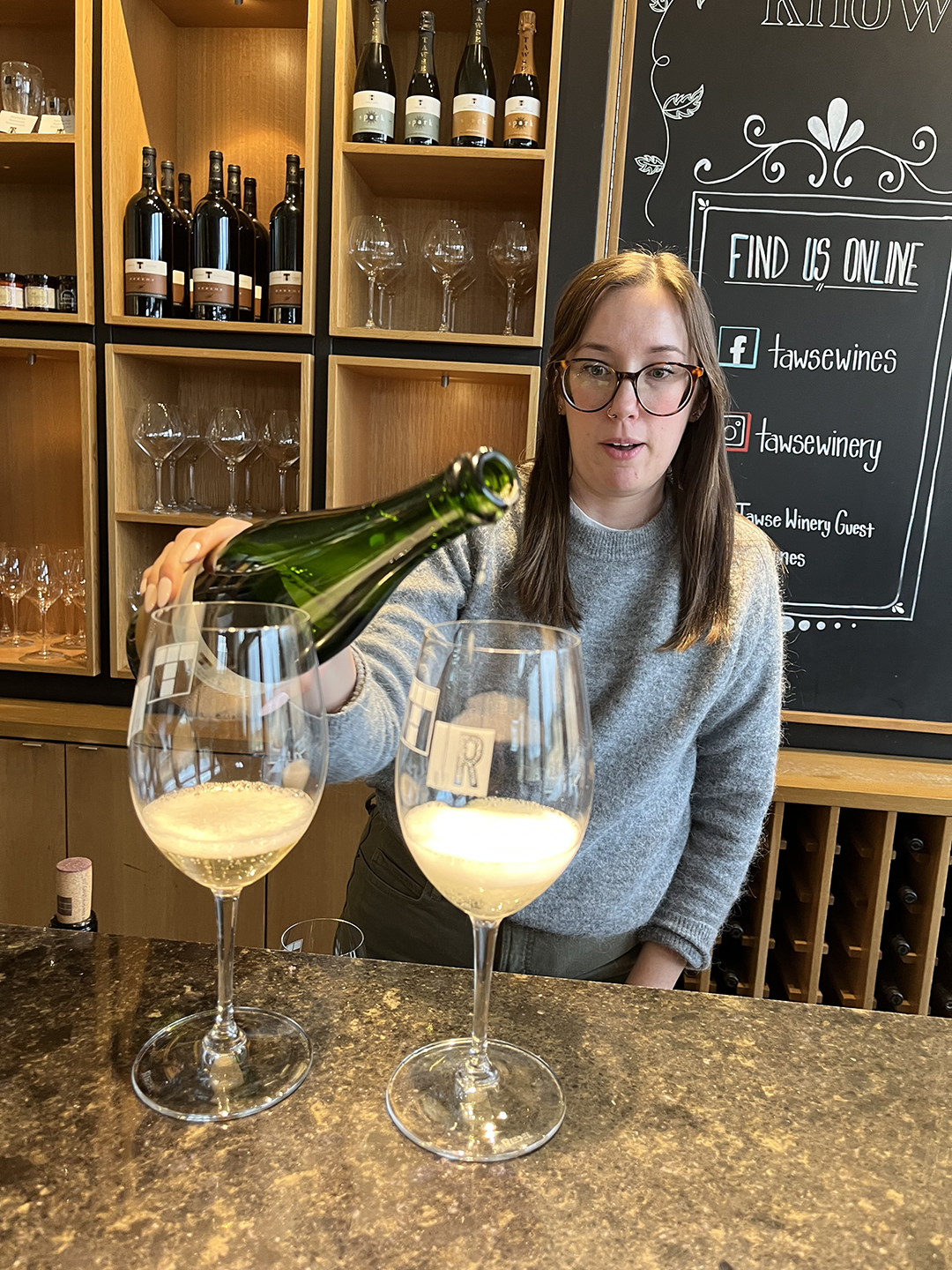
Tawse winemaker Jessica Otting pouring Spark 2022
Monday, January 19th: Last Wednesday I visited Tawse with Dr. Enno Lippold to taste their Rieslings with winemaker Jessica Otting: Tawse Spark 2022, Limestone Riesling 2022, Quarry Road Riesling 2013, Limestone Riesling 2016, Quarry Road Riesling 2016, Karly’s Block Riesling 2016. (Enno was impressed.)

Tawse 2016 Rieslings
He brought along his Dr. Lippold wines, which we also tasted. He left me the bottles so that I could retaste them at my leisure. Here are my notes:
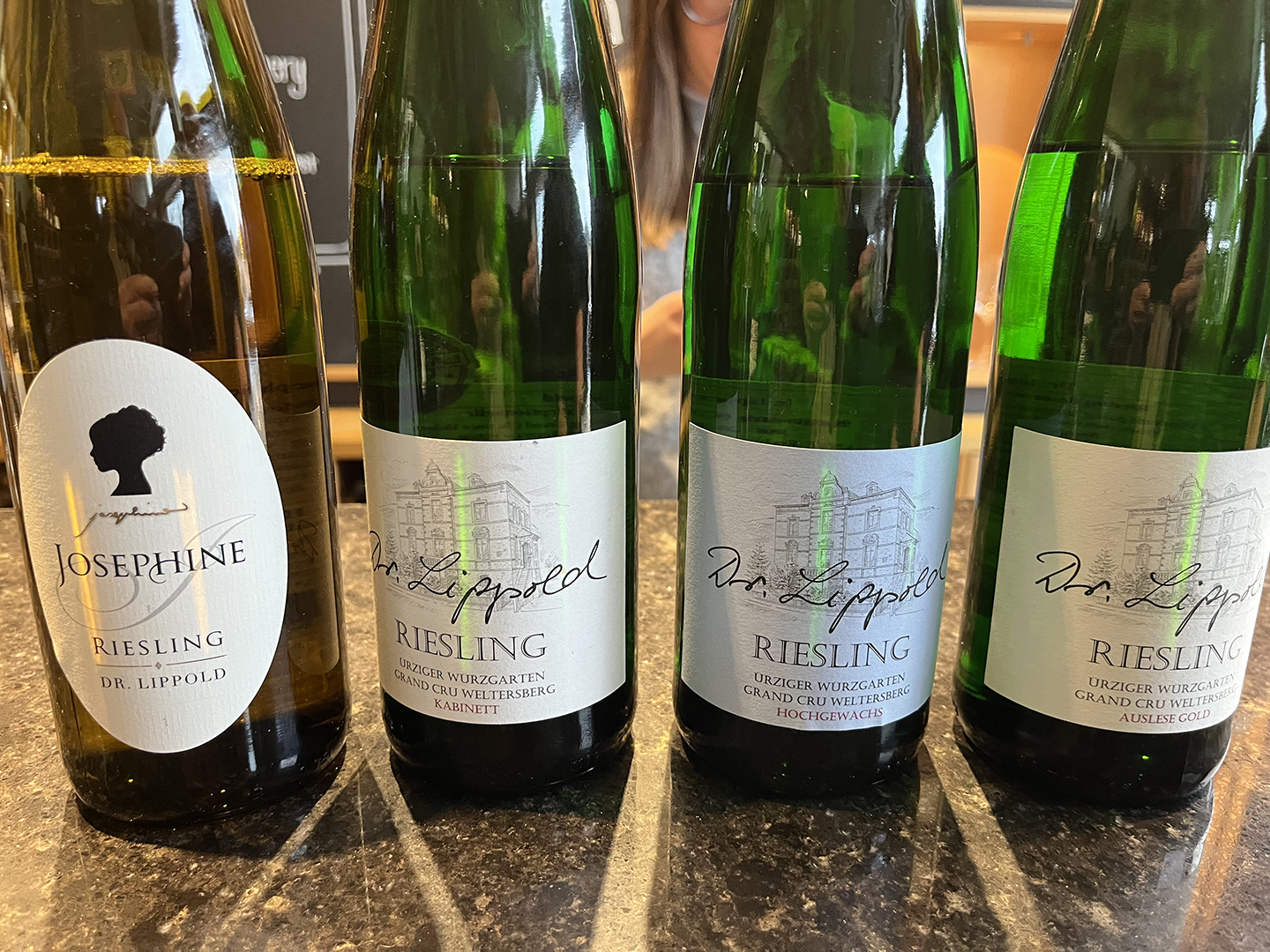
Dr. Lippold Rieslings
Dr. Lippold Josephine Riesling 2021
Bright, pale straw colour; honeyed lime on the nose; light-bodied, off-dry, grapefruit and honey flavours; elegant, beautifully balanced, great length, ending on a floral, lychee note. (90)
Dr. Lippold Urzinger Würtzgarten Riesling Kabinett 2019
Bright, pale straw in colour; a bouquet of grapefruit, lime and honey; light-bodied, crisply dry, lime and green apple flavours with a mineral note; beautifully balanced; great length. (91)
Dr. Lippold Urzinger Würtzgarten Riesling Hochsgewachs Grand Cru 2019
Bright, pale straw, floral, grapefruit and lime on the nose, with a thread of minerality; light-bodied, lovely mouth feel; fresh and lively on the palate with lemony-grapefruit flavours; beautifully balanced and great length, (93)

Dr. Lippold Sparkling Moselle and 2013 Auslese
Dr. Lippold Sparkling Riesling Moselle 2021
Pale straw in colour; active mousse of tiny bubbles; lemon-lime bouquet; light-bodied, elegant, grapefruit flavour with a honeyed note; beautifully balanced, great length. (90)
Dr. Lippold Urzinger Würtzgarten Riesling Auslese Gold 2018
Bright straw colour; honeyed apple nose; light-bodied, off-dry, honey, apple and grapefruit flavours; beautifully balanced. Great length. (93)
Dr. Lippold Urzinger Würtzgarten Riesling Auslese 2013
Old gold colour; honey and apple bouquet; medium-bodied, sweet apple and tangerine flavours; beautiful tension between honeyed sweetness and lively citrus acidity. (94)
Enno brought along samples of the slate and rocks in Urzinger Würtzgarten vineyard.

Dr. Lippold in his vineyard of red Devon slate and volcanic red Rhyolite

Slate and red rhyolite
He also sent me his philosophy of Riesling, which you can read at the end of this diary entry.
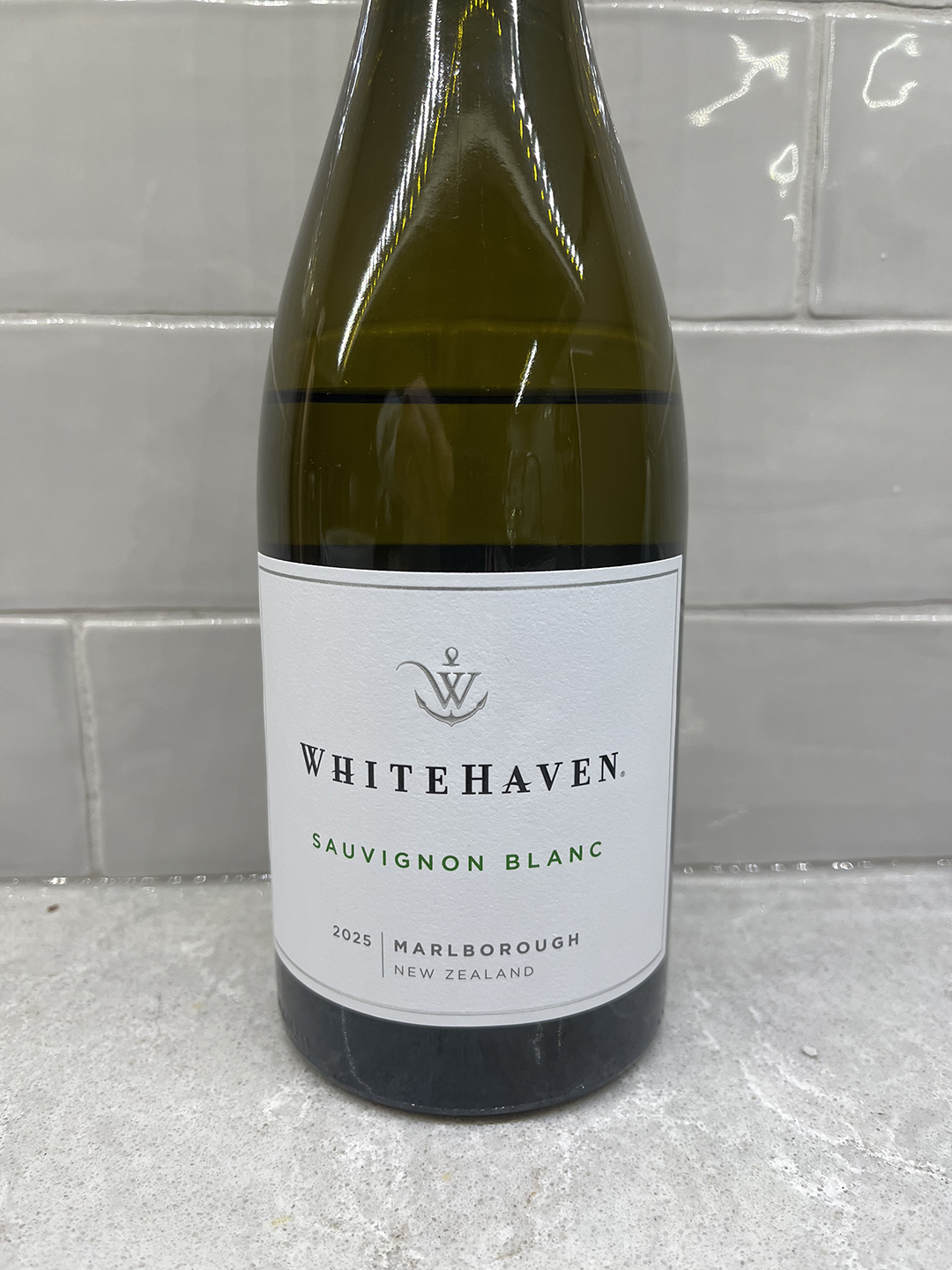
Tuesday, January 20th: Dinner at home – chicken pasta with a bottle of Whitehaven Sauvignon Blanc 2025.
Thursday, January 22nd: Took the train from Burlington to Toronto to attend the ceremonial signing between George Brown College and Niagara College to host the Ontario Wine Awards in alternate years – witnessed by Ontario’s Lieutenant Governor, the Honourable Edith Dumont. The judges of the Ontario Wine Awards also judge the Lieutenant Governor’s Award for Excellence in Ontario Wines.

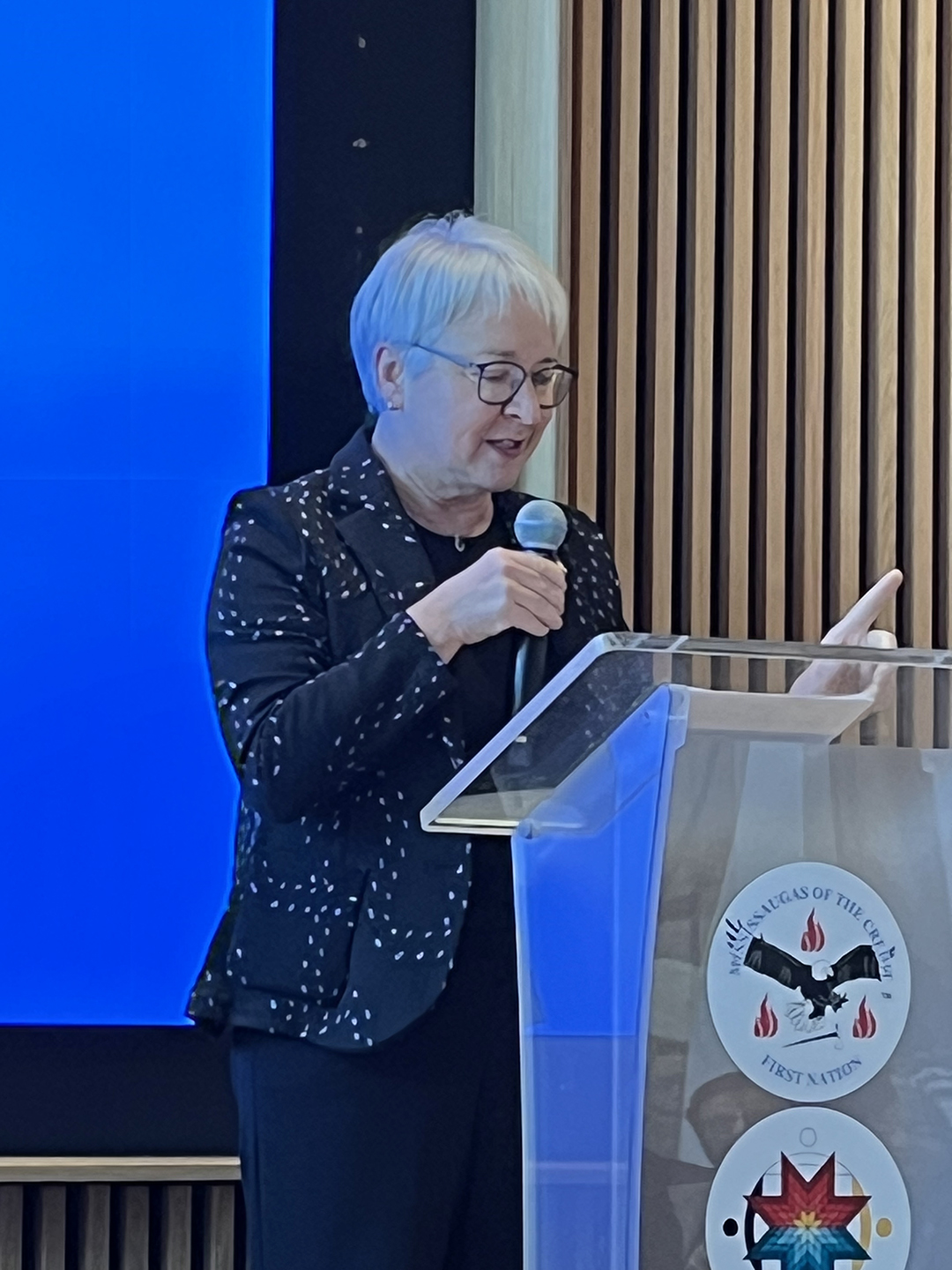
The Honourable Edith Dumont

Minister Nolan Quinn
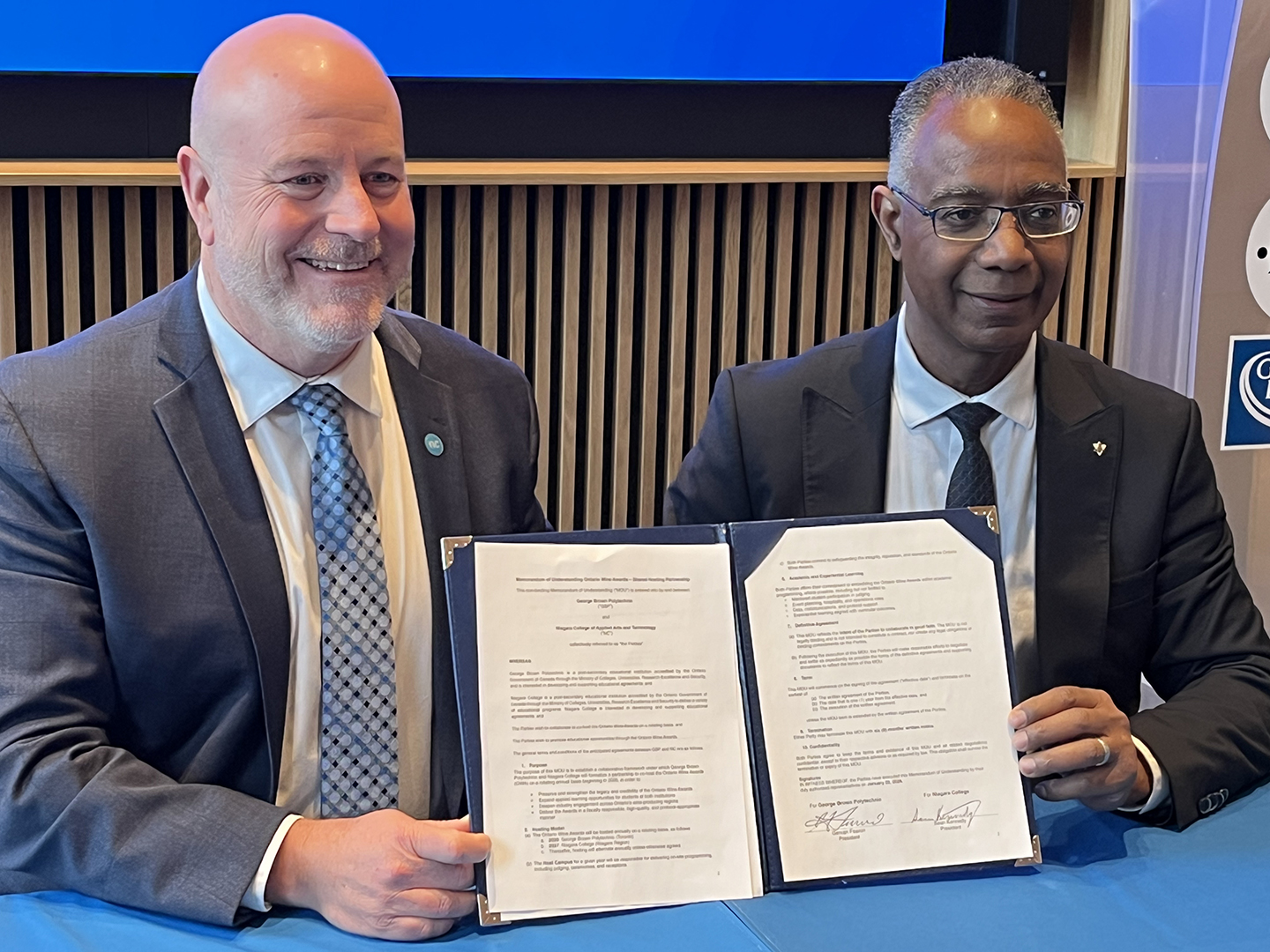
Sean Kennedy, president of Niagara College, and Gervan Fearon, president of George Brown, with their signed agreement
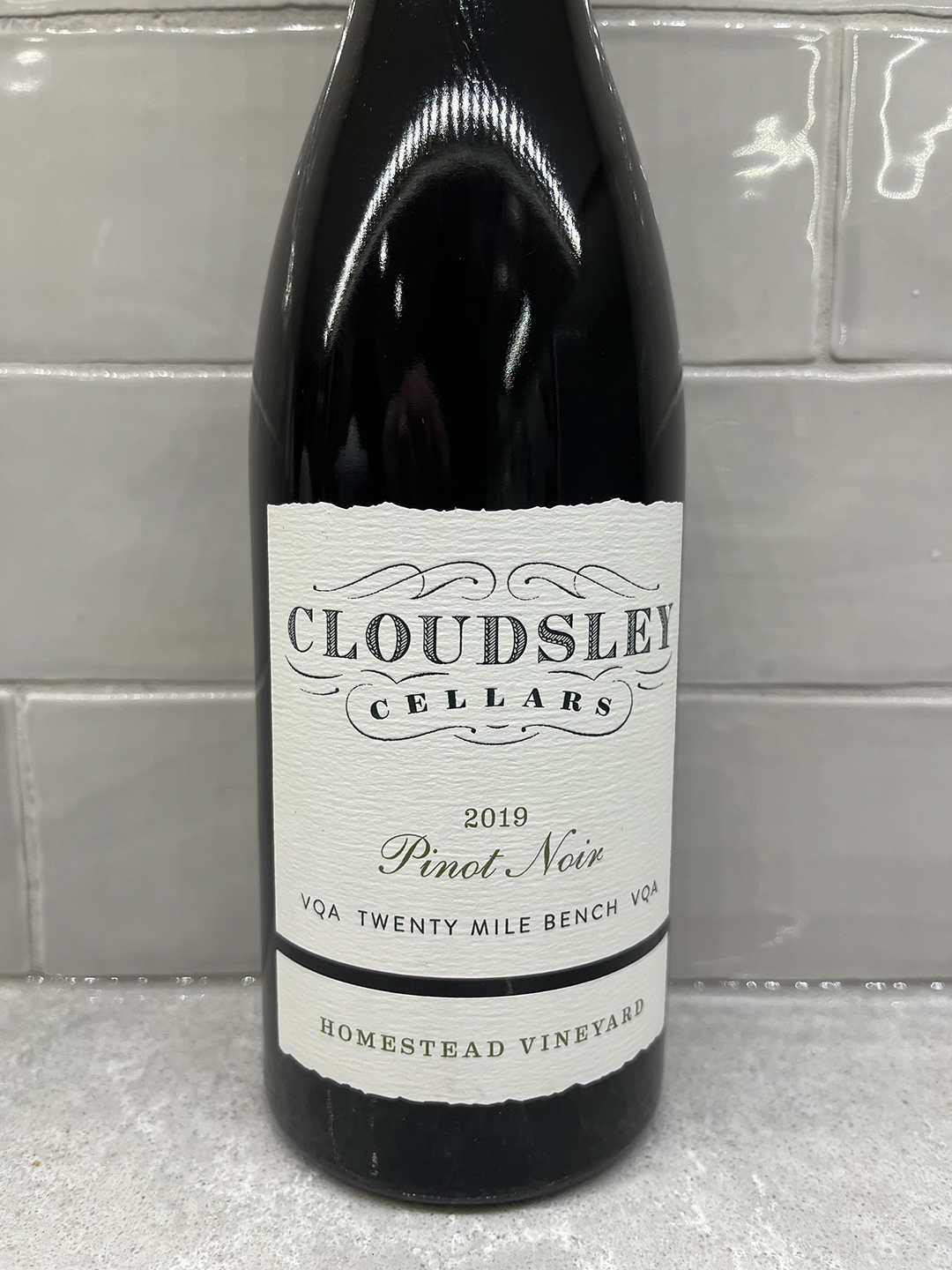
Friday, January 23rd: Dinner of grilled salmon with a bottle of Cloudsley Cellars Pinot Noir 2019 (a delicious wine!).
Enno Lippold writes:
As indicated in the whatsapp message it might be of interest to convey to you the specifics of my property within the “Spicegarden” and my philosophy of growing and vinification. A lot can be found on my website but here are some specific details for you, not available to everybody.
Honestly made Riesling with minimal intervention needs ageing before consumption and as distributors and merchants are no longer prepared to age the wines in their cellars, I do it in mine. Small as I am, I do exactly what Ch Latour began in 2012 – parting from the primeur market > Liberation Tardive.
I am still pondering if phase 1 in vinification – until the bottling is more important or phase 2 – the ageing of the wines in bottles with natural cork (not DIAM which consists of 50% plastic) – is the more important step. There are wines just too stubborn to harmonise, the 2017 Auslese tasted by Margaret Rand and Julia Harding (my website) is such an example, but even more the 2010 which I have not released at all. Tom Stevenson wrote I should keep it for decades and then auction it at an unheard price.
That I am rather restricted with residual sugar is due to the conviction that I must not exploit the technical possibilities – not towards the dry side nor to the sweet side. Trocken Mosel were just the basic low Öchsle wines with lots of acidity which were fermented dry rather easily by the natural yeasts. as everywhere in Europe – a sweetish DRC ? yes of course but nobody speaks about it.
If you may want ask Christopher Burr what sweetish wine he tasted with Robert Drouhin.
“Modern” Kabinetts with 50 gr sugar is for me grape juice from world class vineyards – no terroir at all and taste wise – awful.
Attached you find my viti- and vinicultural approach which is pretty controversial to contemporary habits – time and no tricks of which I know most. As I wrote I follow a triple A order: Artisanal, Aged, Authentic. All my inspirations are coming from the glorious days culminating with Victoria and Albert.
Attached also the portfolio pyramid for my own wines for a better understanding. Sparkling Moselles were on par with any Champagne and are still as my blind tasting in London 2024 proved. See website.
As a second leg, I adore, collect and curate back vintages of Rieslings still in the cellars of my village friends – I gave you the example of the current 2026 back in five decades to 1976.
Viti- & vinicultural methods
Topography The ancient Ürziger Würzgarten – the not reorganized part of 15 ha over the village, amphitheatre like shaped steep slopes
My parcels 60 to 65 gradient steepest slopes:
Neuberg South East exposition – top level
Weltersberg South West exposition – mid mountain
Soil Bedrock: Red Devon slate, cover soil vulcanic red Rhyolite
Vines Neuberg, historic Premier Cru, 100% own rooted, 43 years
Weltersberg, historic Grand Cru, 100% own rooted, 72 years
Education Traditional heart shaped 2 canes, 4–6 buds each, “soft cut”
Work Precision farming, no tilling, cover crop, no pesticides, all work and harvest by hand
Yield Grapes approx. 1 kg per vine – average one bottle
Receiving at winery one hour after picking mid October to mid November
Pressing Horizontal basket press, free run juice, whole cluster pressing
Must flow By gravitation to sedimentation casks, phenolic oxidation over night 12–15 hours
Fermentation Start by own plant and cellar yeasts followed by vaccination with SIHA 7 Riesling yeast
Storage Speidel stainless, sizes 500, 1.000 Liter – each wine is unique – 1300 bottles or less
Phase 1 Fermentation 4–6 weeks, stopping by itself or at defined, restricted levels of residual sugar
Phase 2 8–10 months on free floating lees – instead of battonage
Phase 3 Bottling July, August followed by extended bottle maturation
First release Neuberg – Cuvee Josephine, ANTE min. 18 months, average 30 months after harvest
First release Weltersberg min. 24 months, average 40 months
Ageing regime Reserve 24 months, Grand Reserve 36, Reserve Exceptionelle 48, Reserve Familiale 60 +
MOSEL GREATNESS COMES WITH AGE


