A Wine Lover’s Diary, Part 466: South African Dinner


Jeff Koons’ Dom Perignon 2004 bottle

Monday, October 14: Yes, it’s a holiday, but not for my palate. Tasted the newly released Baron Philippe de Rothschild 2012 Vins de Pays d’Oc, all line-priced at $11.95 and good value. A new label design too. Last vintage the label was black. The 2012 vintage carries a white label with the same stylized vine plant. Frankly, I preferred the black label, which looked sleeker and sexier.

  • Baron Philippe de Rothschild Sauvignon Blanc 2012: very pale straw colour; grassy, green plum with a mineral note on the bouquet; medium-bodied, crisply dry, with a lemony, green plum flavour. Good length. (87)
  • Baron Philippe de Rothschild Pinot Noir 2012: light ruby colour; earthy, cherry nose; dry, lean and sinewy with a sour cherry and wild strawberry flavours, lively acidity and a firm finish. (86)
  • Baron Philippe de Rothschild Merlot 2012: deep ruby colour; plum with a spicy wood note on the nose; dry, medium-bodied, well extracted plum and dark chocolate flavours. Solid on the palate. (86+)
  • Baron Philippe de Rothschild Cabernet Sauvignon 2012: deep ruby-purple colour; cedar, cherry jam nose with a touch of oak spice; good concentration of cherry and blackcurrant flavours with a bitter chocolate finish and ripe tannins. (87+)

My son Guy and his girlfriend Carlee came over for dinner. Opened a bottle of Tinhorn Creek Gewurztraminer 2012 with smoked salmon and Tawse Redstone Cabernet Sauvignon 2010 with flank steak with a spicy rub and green mango salad.

Tuesday, October 15: An 11:30 am radio interview with CBC Quebec’s Jacquie Czemin on my new book, Canadian Wineries. In the evening over to Esther Farlinger’s house for a reception for Canada’s Sports Hall of Fame. Esther is being honoured for her work.

Wednesday, October 16: Last minute arrangements for the South African dinner at St. George’s Golf Club on Thursday, proceeds to a South African charity, called MAD (nothing to do with Mothers Against Drunk Driving; it’s for under-privileged kids). My ex-wife Brenda came to dinner with Barbara Wesson, an old friend from CBC Radio days. Opened a bottle of Quails’ Gate Chenin Blanc 2012 with smoked salmon and Rosewood Merlot Reserve 2010 with BBQ filet steak.

Thursday, October 17: A delivery today of two wines to review – Cloudy Bay Sauvignon Blanc 2013 and a dramatically packaged bottle of Dom Pérignon Brut 2004. The champagne arrived in a black box decorated with Jeff Koons’ limited edition “Balloon Venus.” I’m a great fan of Koons, having discovered his work at the Guggenheim Museum in Bilboa. The bottle has a brassy gold foil. The accompanying notes read: “Jeff Koons’ Balloon Venus symbolizes the continuity of life’s energy, rebirth and sensuality.”

The tasting notes: “On the nose, aromas of almond and powdered cocoa develop gradually into white fruit with hints of dried flowers. Classic toasted notes give a rounded finish and denote a fully realized maturity. On the palate, the wine instantly traces an astoundingly fine line between density and weightlessness. Its precision is extreme, tactile, dark and chiselled. The full taste lingers with the utmost elegance on a sappy, spicy note.” Who writes this stuff!

By 4 pm Deborah and I were at St. George’s Golf Club in Etobicoke setting up the silent auction for the South African wine tasting dinner, presented by the Canadian Southern African Network and grapes for Humanity. The event began at 6 pm with a sparkling wine reception (Graham Beck Brut) before sitting down to dinner and entertainment by South African singer Lorraine Klaasen and her band.


Lorraine Klaasen performing

Here’s the menu with the wines that were served:

Boerwors Rillette
Szechwan Pepper Basket, Caramelized Onion, Peach Chutney
Rickety Bridge Chenin Blanc 2012

Spiced Poached Pear with Grilled Citrus Goat Cheese
Apple Smoked Duck, Walnut Vinaigrette
Hermanuspietersfontein Nr. 3 Sauvignon Blanc 2012
Boekenhoutskloof Semillon 2009

Roast Capsicum and Bilbong Salad
Smoked Cherry Mustard
Lemberg Spencer Pinotage 2011

Braised Water Buffalo
Samp and Bean Potjiekos with Blackcurrant Coulis
deTrafford Cabernet Sauvignon
Meerlust Rubicon 2008

Malva Pudding with Amarala
Thick Vanilla Custard

Served on the table with coffee: Dadel Balletjies

Friday, October 18: A Vintages release tasting this morning. Always nice to start the day off with a taste of Krug Grande Cuvée. Dinner at our neighbour Sally’s. I brought along a bottle of Norman Hardie County Pinot Noir 2011, which went beautifully with Sally’s pork loin wellington.

Saturday, October 19: In the evening Deborah and I drove to Burlington for a fund-raiser for breast cancer, called Beauty and the Bistro. Debbie Levy of Dairy Farmers of Canada conducted three wine and cheese seminar during the course of the evening. Four cheeses from four provinces were matched with four Ontario wines.

  • Comox Brie from BC with Henry of Pelham Sauvignon Blanc 2012
  • Avonlea Clothbound Cheddar from Prince Edward Island with Niagara College Teaching Winery Dean’s List Chardonnay 2010
  • La Belle-Mère (semi-firm washed rid) from Quebec with Casa-Dea Estates Gamay 2010
  • Five Brothers (Gouda/Appenzeller) from Ontario with Burning Kiln Strip Room 2012
Posted in Uncategorized, Wine Lover's Diary | Leave a comment

A Wine Lover’s Diary, Part 465: Tasting Season Begins

Monday, October 7: October and November are always busy months in the wine calendar. It’s the time when winemakers can travel. I was meant to go to a tasting of 70 wines from Lake Erie North Shore wineries but I attended Harold Halpern’s funeral instead. I had known Harold for 30 years but didn’t know that he was a keen photographer and a pianist. Wrote my 680News wine reviews and went to dinner with Barry Chaim at EDO to tell him all about our Japanese trip. Still feeling some effects from jet lag.

Tuesday, October 8: A meeting this morning with Suresh Doss, David Rose and Sandy Kurbis to discuss the 20th anniversary of the Ontario Wine Awards and the 10th anniversary of sip&Savour Ontario. Then on to the ROM for the annual Wines of Chile tasting. There were 25 tables and 117 wines available for tasting. I concentrated on the red wines and was delighted to discover a winery whose wines I had never tasted before – Villaseñor in Talca. They make a very tasty blend of Carmenère, Merlot and Cabernet Sauvignon called Villaseñor Ensamblaje 2009 and a beautifully balanced Villaseñor Cabernet Sauvignon-Syrah 2010. Other wines I scored 90 points were Volcanes de Chile Parincota 2010 (a Syrah-Carignan blend), Anakena ALWA Cabernet Sauvignon 2010, Pérez Cruz Carmenère Limited Edition 2011 and Carmen Gran Reserva Carmenère Syrah 2009.

Wednesday, October 9: Recorded my 680News wine reviews and then drove up to the Profile Wine group to pick up wines for the annual Pauwels/Aspler reunion dinner.

Thursday, October 10: Down to the ROM for the annual Ontario wine tasting. Forty-three wineries showing 169 wines. I wanted to taste all the Pinot Noirs before I moved on to other varieties. Pinot Noir, the most fickle and demanding of grapes, is alive and well in Ontario. Winemakers like Norman Hardie, Thomas Bachelder, David Sheppard at Coyote’s Run, Paul Battilana at Casa Dea, Deborah Paskus at Closson Chase, Angelo Pavan at Cave Spring, Marlize Beyers at Hidden Bench, Ross Wise at The Organized Crime Winery and Shiraz Mottiar at Malivoire are all very respectful of this demanding variety, even in a wet vintage like 2011. Made in Burgundian style rather than emulating New Zealand or Oregon, Ontario Pinots are restrained and elegant, speaking to the soil in which they were grown.

I was particularly struck by the difference in flavours of Coyote’s Run Red Paw and Black Paw Pinots, both from 2011 vintage. These two plots are contiguous but the wines they produce, because of the soil structure, are very different. Like the diversity between a Côte de Beaune and a Côte de Nuits. Other wines I really enjoyed were Jackson-Triggs Niagara Grand Reserve Shiraz 2011 and Charles Baker Ivan Vineyard Riesling 2012.

Across the road at the Gardiner Museum, Wines From Spain was holding a sherry tasting they punningly called “Drink More Sherry. Get Flor’d.” On the inside of the program was this note: “We would like to remind you that the sherries in this tasting contain anywhere from 15 to 22 percent alcohol by volume. Please taste responsibly, and please make liberal use of the provided spit buckets.” I happen to love sherry and every year I predict that it’s going to make a comeback. On the strength of what I tasted here I certainly hope this is the year. Particularly struck by the wines of El Maestro Sierra, Fernando de Castilla and Bodegas Traición. Best value: Gonzáles Byass Leonor Palo Cortado at $18.95.

In the evening Deborah and I went to Rossini’s for the reunion dinner. We were 18 in all and enjoyed wines from the region we’ll be touring next May, Tuscany and Umbria: Poggio al Tresoro Solosole Vermentino 2011, Fattoria di Magliano Heba Morellino di Scansano 2010 and Tenuta di Martucino Brunello di Montalcino 2008.

Friday, October 11: Went down to the LCBO to taste the new general list release. Stunning Piper Heidsieck and an Avantegarde Dornfelder Red worth $14.95 for the bottle alone. Soft & fruity with a touch of residual sugar.


Avantegarde Dornfelder Red Bottle


Piper-Heidsieck Champagne Bodyguard Brut

Wrote my On The Go magazine column and began researching the wineries that we will try to visit on the May wine tour. Dinner, spicy Italian sausages with Quails’ Gate Merlot 2011 (dense purple; intense, vanilla, black fruits, spicy oak bouquet; well extracted sweet fruit with dark chocolate flavours and grainy tannins. Good length (90)).

Posted in Uncategorized, Wine Lover's Diary | Leave a comment

A Wine Lover’s Diary, Part 464: Jet-Lagged

Monday, September 30: Arrived home about 6 pm from Tokyo. Had an omelette and a bottle of The Grange of Prince Edward Gamay 2010 and tried to stay up as late as possible to get back to a normal sleeping pattern.

Tuesday, October 1: Awoke at 4:30 am and got down to the business of answering emails and going through two weeks’ mail. Deborah picked up Pinot the Wonderdog from Innisfil, where she has been staying with our dog sitter. She barked all the way home, which is her wont.

Did some tasting in the afternoon. Before I left for Japan I opened a bottle of Cono Sur Bicicleta Chardonnay 2012. I left one-third in the Savino (a glass column with a stopper and a float that creates a physical barrier between the surface of the wine and air). I left it in the fridge for two weeks and tasted it today. The wine was remarkably fresh and lively – so here’s one wine gadget that works.

  • Hester Creek Chardonnay 2012 (Okanagan Valley – $24.95): old gold colour; buttery, toasty, peach nose; full-bodied, peachy-melon flavours backed by toasty oak, generous on the palate and fleshy with fresh acidity. (89+)
  • Niagara College Teaching Winery Pinot Noir Canadian Oak 2011: tawny ruby colour with a nose of raspberries and underbrush and obvious oak; medium-bodied, dry and sinewy on the palate; very Burgundian in style with a firm tannic finish. Should age for 2–3 years. (89)
  • Niagara College Teaching Winery Cabernet Franc 2011: ruby colour; smoky, toasty red berry bouquet; dry, medium-bodied, creamy mouth feel, elegant. Well-structured flavour of red and blackcurrants, finishing firmly. A fine effort in a difficult vintage. (89+)
  • Niagara College Teaching Winery Meritage 2011: deep ruby colour; cedar and red berry nose; elegant, claret-style with cherry and currant flavours; firm on the palate, restrained with a tannic lift on the finish. Again, a good effort in a difficult vintage. (90)
  • Hester Creek Merlot Block 2 Reserve 2011 (Okanagan Valley – $28.95): deep purple-ruby; tarry, smoky, plum and black cherry nose with pencil lead notes; sweet fruit with plum and mocha chocolate flavours; rich and full on the palate with balancing acidity and a thread of minerality. (91)
  • Hester Creek Cabernet Franc Block 3 Reserve 2011 (Okanagan Valley – $28.95): deep purple colour; spicy, plum and blackcurrant with a floral top note; medium-bodied, elegant, lovely mouth feel with bright acidity. Seamless on the palate. (91)
  • Hester Creek The Judge 2010 (Okanagan Valley – Cabernet Franc, Cabernet Sauvignon, Merlot – $45): dense ruby colour; cedar, blackcurrant and pencil shavings on the nose; ripe fruit with a smoky, tarry note, coffee bean and blackcurrant flavours with lively acidity and mellow tannins. An impressive wine. (92)

Wednesday, October 2: Still catching up on emails but not on sleep. They say it takes a day for every time zone crossed to get back your sleep rhythm. Toronto is 13 hours behind Tokyo. Ho hum.

Tried to return an electrical adapter to The Source. Deborah bought it before we left for Japan but when I tried it in Tokyo it didn’t work. The manager said we had to return the box with it. It’s in the garbage in a Tokyo hotel room. What kind of a policy is that! If the gadget doesn’t work, it doesn’t work and they’re not going to try to sell it to someone else.

Deborah and I went to see The Butler. Nearly fell asleep and spilled my popcorn. A late dinner of pasta with chicken and a bottle of Bersano Castalunga Barbera d’Alba 2011 (deep ruby colour; a nose of cherry with an earthy note; dry, medium-bodied with cherry and cherry pit flavours ending on a herbal note. Good acidity. Good value at $11.95 (87+)).

Thursday, October 3: A tasting at Doug Towers’ for www.winerytohome.com. My sleep rhythms are still interrupted. I’m awake at 2 am and find it hard to fall back to sleep.

Friday, October 4: A Vintages release tasting for November 9th. The LCBO are bringing out the good stuff for the Christmas period.

Saturday, October 5: After lunch I went to the opening of Château des Charmes’ new wine store in Delisle Court. They’ve taken over Chris McDonald’s old chocolate shop. Tasted Château des Charmes Savagnin Icewine 2009. Delicious.

In the evening Deborah and I went to tasting in a private house. Each of us brought a bottle. The line-up was:

  • Domaine Servin Chablis Vaillons 2010
  • Bouchard Père & Fils Meursault Les Clous 2010
  • Blue Mountain Pinot Noir 2011
  • Marques de Riscal Riserva 1993
  • Château de Pez 1993
  • Château Ruasan-Gassies 1982

Then to dinner with Gordon Pape and Esther Farlinger at Mistura, where we made a big dent in two bottles of DeLoach Pinot Noir 2010.

Posted in Uncategorized, Wine Lover's Diary | Leave a comment

A Wine Lover’s Diary, Part 463: Japan, Part 2


Canadians in kimonos

Saturday, September 21: Breakfast at Ryokan Seryo is a serious affair with cooked salmon, pickled vegetables, rice, hot tofu and tea.

We took two taxis back to Kyoto and checked in to the Kyoto Tokyu Hotel. Deborah and I opted to go to the flea market in the grounds of the Toji Temple. To get there we purchased a day bus pass. It was a sweltering day (31°C) as we walked around the hundreds of stalls selling everything from old kimonos to bric-a-brac, street food, one-off clothes, pottery, hand-crafted jewellery, ugly hats and pine needle sprigs, charcoal, samurai swords, coins, etc.

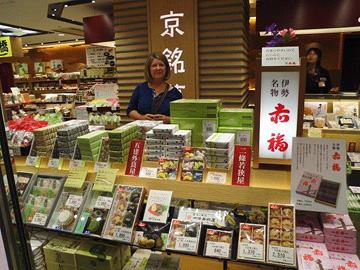
Then we went for lunch at Takashimaya. The food court in the basement is amazing. Gorgeously presented and wrapped food. Cantaloupes that cost $63. I bought a bottle of Japanese wine to bring home – Chateau Mars Cabernet Merlot 2009.

In the evening our group attended a Geiko/Maiko experience at an Ocha-ya (tea house) in the geisha district of Gion. Geiko is the Kyoto term for geisha and maiko is a geisha-in-training. We had to walk up a narrow alley off the main street to find it. We took off our shoes before moving upstairs to a room where we sat at a low table, legs stretched out or folded under us. We were presented with a tray of candied walnuts, marinated cucumber, sticky rice wrapped in aubergine skin with mustard, clams in a sweet sauce, and a sweet glutinous paste wrapped in a leaf. Then the geiko and maiko dressed in elaborate kimonos entered and introduced themselves: Tsunemomo (“Call me Momo”), who is 26, and Tometoiuyu, who is 16 and has only been studying to be a geiko for one month. She spoke excellent English, having spent four years in New Zealand – by herself! A third woman, middle-aged, named Miyako played the shamisen (a three-stringed triangular guitar) and waited on us, filling our glasses with beer or sake at every possible occasion.


Momo and Tometoiuyu perform a traditional dance

The food started arriving: egg custard with ginkgo nuts; eel and crab; pike, tuna, squid and eel sushi; cooked octopus and crab; tempura. The girls danced to the shamisen and more food arrived, all the time our glasses being refilled: fried hamo sushi; soup with eel, mushroom and cucumber; and finally a dessert of glutinous rice paste with sweet bean paste and green and black grapes.

Then Tometoiuyu asked us if we wanted to play a game called which turned out to be a drinking game called konpira: using an upturned sake cup each player, kneeling opposite each other at a low table, had to touch the top of the cup with a flat hand in turn or remove it from the table. If the cup is taken you had to put your fist on the table in its place. If you put the flat of your hand you lose and had to chug-a-lug a glass of wine or sake. All of this to the accompaniment of the shamisen as the rhythm of the music gets faster and faster. Needless to say, much alcohol was consumed which, I guess, is the point of the game in terms of financial gain for the house. When the meal was over we were told that our taxis had arrived.

We left thinking, through some miscommunication, that our bill had been prepaid. We were almost at the taxis when the woman owner and the two girls came running after us. The bill was exorbitant and the ocha-ya did not take Visa. We didn’t have enough cash to cover. So we tried to find a 7/11 with an ATM machine but with no luck. After some negotiations we managed to muster a little under half the bill and promised to get the rest to the manager through the friend who had booked the evening for us. At 9pm the two girls went on to their next engagement and we returned rather sheepishly to our hotel.


7/11 breakfast

Sunday, September 22: After a breakfast of white bread sandwiches at a 7/11 five minutes from the hotel (7/11’s ATM has become my bank), we met our guide, Reiko Kanari, who took us by a series of three buses to the Kinkakuji Temple, a UNESCO World Heritage site, with its three-storey golden pavilion. It was founded in 1398; its two upper floors were covered in gold leaf. An unbalanced monk burned it down in 1950 and it was rebuilt to the original design in 1955. Forty pounds of gold were used to make the gold foil hat covers the walls outside and in. In the grounds is a 600-year-old fir tree supported on a bamboo trellis that looks like a ship at sail.


Kinkakuji Golden Pavilion, Kyoto


600-year-old pine tree

Our next visit: Ryoanji Temple with its dry landscape garden created by a Zen monk around 1500. The rectangle measures 25 meters by 10 meters. The raked white gravel (to express water) is set with “islands” of 15 rocks, strategically placed so that you can’t see all 15 from any single perspective. Fifteen is the number of perfection in Buddhism, being the number of days between the new moon and the full moon. In Kyoto there are 1600 Buddhist temples and 400 Shinto shrines.


Entrance to Nijo Castle, Kyoto

Next stop, the moated Nijo Castle, another World Heritage site, built in 1603 for the first Tokugawa Shogun. Lunched at Kyoto Mamemachi, whose specialty is tofu. Kyoto is famous for its tofu because of the quality of its water. We had soy bean curd cooked with vegetables, a salad with taro root, eggplant, bonito flakes, bitter green pepper and soy milk crust; tempura of vegetables and green tea; dessert – tofu flan with peeled grapes. The tofu, green onion, bonito flakes and ginger followed by rice with pickled vegetables and seaweed.


Pickled vegetables

After lunch we walked through the vast Nishiki covered market to get to Fukuju-en, a tea shop on four floors. The company has been in business for 120 years. Here we experienced the traditional tea ceremony. Which meant climbing into a tatami-floored room through a small hatch once we had removed our shoes. The woman in a kimono who performed the ceremony with exquisite precision was 72 years old but could have passed for late 40s. The tea ceremony was introduced into Japan in the sixteenth century, originally performed by monks at midnight to keep them awake. We were first given a plate of sweet gelatinous cakes dusted with green tea powder to mitigate the bitterness of the green tea to come. When served your bowl of tea you have to turn to the person next to you and say, “I’m drinking my tea before you,” and then you turn to the tea-master and say, “I am enjoying your tea.” Once you have consumed it you have to slurp up all the foam noisily.


Fukuju-en tea master about to perform the tea ceremony

Back at the hotel, we had a quiet evening, picking up a sandwich at our local 7/11.

Monday, September 23: Left the hotel at 8:30 am to take the train to Nara, an hour’s journey. Nara was the first permanent capital of Japan. Here we visited the Kasuga Grand Shrine. Nara is famous for its deer park, where hundreds of deer roam the parks and public spaces. They challenge you for food and will eat the maps out of your hands. If a motorist kills a deer he or she has to pay a fine. There are stands selling wheat cakes for the deer. The proceeds go to hospitals to care for pregnant deer.


Deer in Kyoto’s deer park


Metal lanterns in the Kasuga Grand Shrine

Todai-ji Temple, a World Heritage Site, is the largest wooden structure in the world. It was built around a 45-foot bronze statue of the Buddha. On the façade is a window that is opened once a year to expose the Buddha’s face. The hand positions, one raised, one extended, palm open, signifies, “Don’t be afraid. I will save you.” Outside the temple is a wooden statue of an ugly monk in the lotus position. It is said if you rub a part of his anatomy where you have pain and touch that part of you, you will be cured. In the grounds are avenues of 2,000 stone lanterns and 1,000 hanging metal lanterns.
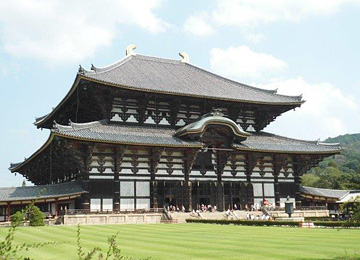

Todai-ji Temple, the largest wooden structure in the world


Todai-ji Temple Buddha


Monk with curative powers (outside Todai-ji Temple)


Garden of Three Thousand Lanterns


Relaxed fawn

We lunched at Fukutoku udon noodle shop (beef noodles and tempura), then took the train back to Kyoto to visit the Heian Jingu Shrine (built in 1895).


Kyoto train station


Japanese garden


Monks at prayer


Three little maids from school

Deborah and I went on to see the Manga Museum, which is housed in a former school. There are rooms filled with manga comics and books dating back to 1945. These graphic stories are central to Japanese culture and cover all aspects of life. There are even gay and lesbian porn manga comics. According to Wikipedia,

The medium includes works in a broad range of genres: action-adventure, romance, sports and games, historical drama, comedy, science fiction and fantasy, mystery, suspense, detective, horror, sexuality, and business/commerce, among others. Since the 1950s, manga has steadily become a major part of the Japanese publishing industry, representing a ¥406 billion market in Japan in 2007 (approximately $3.6 billion) and ¥420 billion ($5.5 billion) in 2009.
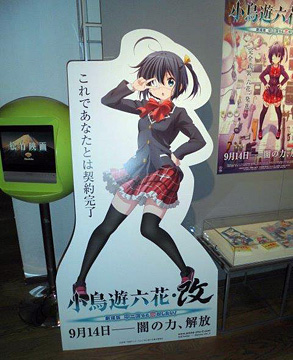

Manga cartoon character

Dinner at Kikunoi Restaurant for a kaiseki banquet based on seasonal produce, prepared by Chef Yoshihiro Murata. The wine we ordered was Bechar Fiano d’Avellino 2011.


Dinner at Kikunoi restaurant: deep-fried tilefish course
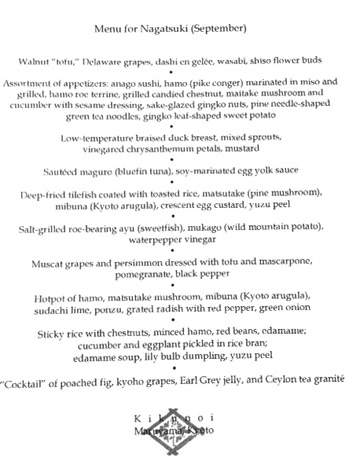
Kikunoi menu

Tuesday, September 24: Took the bullet train to Hiroshima and checked into the ANA Crowne Plaza Hotel before heading off to the ferry with our guide, Jasmine, to the island of Miyajima with its emblematic torii gate set in the shallow water. This village is, apparently, one of the three most scenic places in Japan. There are deer here too.


Bullet train to Hiroshima


Otorii Gate, entrance to Miyajima

We tour the Itsukishima Shinto shrine (another World Heritage site) which, like Venice, is built over water, set on pine stakes driven into the bed of this inland sea. There is a wedding happening in the shrine – the bride and groom are dressed in ceremonial wedding garb. In a temple there are beautiful, elaborately designed sand mandalas made by Tibetan monks.


Traditional Japanese wedding dress


Off on honeymoon


Sand mandala made by Tibetan monks
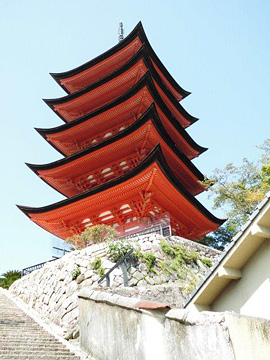

Pagoda, Miyajima island

For lunch, a local speciality – okonomiyaki, a crepe with different fillings, with cabbage and Chinese noodles topped with an omelette doused in a sweet, spicy, garlicky sauce.


Okonomiyaki

Walking through the Omotesando shopping arcade we saw the World’s Largest Wooden Rice Scoop, made from a 270-year-old zelkova tree. It measures 7.7 metres long and weighs 2.5 tons.


World’s largest rice spoon

In the afternoon we took a boat back to the Hiroshima Peace Park, a memorial to the atomic bomb victims. The symbol of the destruction that is left standing is the dome, a government building on the river near the T-shaped bridge that was the original target on August 6th, 1945.


Hiroshima Cenotaph with the Dome in the background
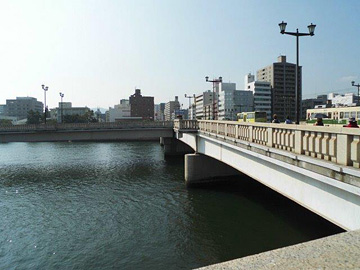

The T-bridge in Hiroshima, the intended target for the A-bomb

The bomb was dropped at 8:15 am and exploded at a height of 600 metres above the ground, killing 140,000 – half the population of Hiroshima. Touring the museum was a sombre experience. At the entrance is a large stone inscribed with a message from Pope John Paul II on his visit to Hiroshima in February, 1981. We saw a tree that stood within 1350 meters of the hypocentre of the blast. It had been transplanted outside the museum. We checked into the ANA Crowne Plaza and dined in their Unkai restaurant on the fifth floor: shrimp tempura and rice with a bottle of Georges DuBoeuf Beaujolais 2011.


Hiroshima manhole cover

Wednesday, September 25: Today, Fukuoka and Hakata. At Fukuoka station we linked up with our guide, the lovely Noriko Mitsuyasu, who lived in Toronto for a few years. After checking in to the ANA Grand Plaza Hotel we visited the Tochoji Temple. Originally built in 806, it houses the largest wooden statue of a seated Buddha in Japan.

Next stop, the Dazaifu Tenmangu folk museum where we viewed a film of the annual Hakata Gio Yamakasa Festival, which happens in July. Twenty-six men in competing teams, wearing a skimpy cloth panel over their privates, take turns running a two-ton float around the Kushida shrine and through the streets along a 5 km route. All the while spectators throw water over them to make the pavement slick.


A model of the Yamakasa event

We dropped in to Noriko’s family’s tea shop, Mitsuyasu Seikaen Chanho. Tea has been the family business for twelve generations. Lunched in a noodle house and then took a train to Dazaifu Tenmangu Shrine and the Kyushu National Museum. The Komyozenji Temple has a lovely zen garden. Here we had the first rain of our trip.


Zen garden

In the evening we had dinner at a yatai – literally translates as “night table.” It’s really just an open shack on the sidewalk with 10 stools around a counter. The raw food is displayed in a glass cabinet and the owner and his wife prepare it on a grill and a hot plate. We ordered sake and Asahi Super Dry Beer and the following barbecued dishes: shrimp, pork gristle, tongue followed by cooked whale, and noodles. We kept ordering and must have made the restaurant’s day because the wife gave us all disposable lighters!


Yatai – the Night Table in Fukuoka

Thursday, September 26: Took the train to Arita, a 90-minute trip, where we hired a jumbo taxi for the days touring. Arita is the pottery centre of Japan. You can tell where there is a pottery factory by the tall brick chimneys that stands over the kilns.


Genemon kiln

Our first visit is to the Genemon Kiln, the oldest in Arita, where we are shown the exquisite (and expensive) works created by their artists. Fourteen generations of potters have worked here. The 13th generation potter was designated a Living National Treasure. The company’s manager, Tsunehisa Aiga, explained that pottery created for the aristocracy and government officials was limited to four colours – red, yellow, green and blue – while pottery made for commoners had a full range of colours. It was only after watching the painstaking craftsmanship of the potters and artists who decorated their work that I understood why these works of art are so expensive.


Hand-painting plates at the Genemon kiln

Lunched at a local restaurant famous for its koi dishes. The first dish was a small bowl of eggplant, cucumber and deep-fried koi mixed with raw egg and spicy miso sauce. This was followed by a large bowl that was filled with a circle of flaked koi sashimi shaped like a flower and set on a bed of crushed ice with a miso leaf and shaved daikon in the centre. (Felt a little bad about eating those overgrown goldfish but they were delicious.) Next, a pot of egg custard with cooked shrimp and ginkgo nuts, mushroom, fishcake and chicken, followed by a plate of deep-fried koi as addictive as potato chips. Finally, a bowl of miso soup with koi and koi roe.


Flaked koi

After lunch we visited a modern kiln, Hakusan, the company that supplied EDO restaurant in Toronto with its dishes. Most of the staff at Hakusan are deaf; they have a policy of hiring the hearing impaired, whom they train to create their range of pottery. Finally, we visited what looked like a pottery mall, a whole avenue of stores on both sides, including one that had incorporated designs by John Lennon and Picasso in their plates and cups.

We then drove to our ryokan in Saga, where we were greeted with green tea and a sweet of bean paste. Changed into a kimono for dinner. The menu, 11 courses beginning with a tiny glass of plum sake, tofu and vegetables, squid with citrus, octopus and salmon, sesame tofu with eggplant; sashimi of cuttlefish, kampachi and mackerel; soup with fishcake and crab, skin of tofu and enoki mushrooms; plaice with mashed potatoes laced with red pepper, marinated walnuts and lotus root; sweet potato and chicken with aubergine covered with wheat gluten; tempura of sweet potato, lotus root, shrimp cake and Korean carrot; Saga beef, which we cooked ourselves in a heated pot with butter, and mushroom and green pepper; a small bowl of pickled vegetables; miso soup, and  a bowl of rice; a cup of roasted green tea; dessert – stewed plum with Asian pear and a lychee glaze.
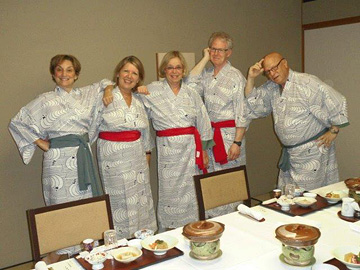

The gang at the ryokan

Friday, September 27: A traditional breakfast of soy milk, vegetables with kiwi salad, hot tofu with a creamy rice vinegar dressing; and then came the Western breakfast of scrambled eggs and ham with toast.

Took the bus from Saga to Nagasaki. Nagasaki is a beautiful city built in the hills, resembling San Francisco with its steep, winding streets. Our first visit is to Dejima, a 15,000-square-metre, fan-shaped island that was created in Nagasaki Bay. In 1634 the Shogun had the island constructed by digging a canal. It became a ghetto for the Portuguese merchants. The island became the single entrance to Japan for Portuguese and Dutch traders in the seventeenth century until the Meiji period began in 1868, when the country was opened up to foreigners. The traders could only access the mainland through a single narrow doorway. Ultimately, the island became the home of employees of the Dutch East India Company. The Dutch were not allowed to hold any religious services on the island for fear of them proselytizing the Japanese, and they celebrated Christmas clandestinely as the winter solstice.

When our group of seven Canadians arrived at the Dutch sea captain’s house, we were greeted by smiling officials, who announced that one of us was the three millionth visitor to the house since 2006. First we thought it was a TV show gag but when we were ushered upstairs there were three TV cameras and twelve photographers and journalists waiting to interview us. Leslie, speaking on our behalf, was presented with a traditional coffee cup and a pass that gave us two free lunches in the restaurant and the opportunity for each of us to dress in kimonos, which we could wear for 30 minutes as we walked around the compound.
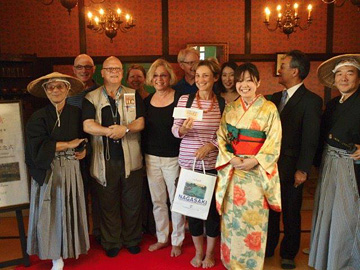

Three millionth visitor celebration

For lunch in the Dejima International Club Restaurant I ordered a beef curry.


Bust of Thomas Blake Glover in his garden


Thomas Glover’s house

Our next stop was Glover Gardens. Thomas Blake Glover, a Scot, lived commonlaw with a Japanese woman who had been married to a samurai. A tea trader and arms dealer, Glover brought the first steam train to Japan (1865), built the country’s first dry dock, and founded the Japan Brewery Company that would later become Kirin.

Kirin Beer label from 1889

The moustache on the dragon on Kirin’s labels is said to replicate Glover’s. Glover also helped found the ship-building company that would become Mitsubishi. His house, a meandering bungalow set high above Nagasaki, has a magnificent panoramic view of the city and its harbour.


Funatsu chef Kazuhiro Matsutake

For dinner we went to Kazuhiro Matsutake’s Funatsu restaurant, a tiny place with ten stools at the counter and a small private room behind the kitchen. Kazuhiro, the father of Hitomi, our guide in Tokyo, was EDO’s original chef in Toronto 23 years ago. With a bottle of Casillero del Diablo Chardonnay 2012 we had the following menu: salted ginkgo nuts, shrimp tempura and a salad with chicken and shrimp; waygu beef; conger eel with a miso and egg white dressing, Chinese lettuce, tofu skin and burdock; steamed crab with soy vinegar; soup with a fish and shrimp cake and mushrooms; green tea; rice and salmon cake with bonito flakes. And finally, Asian pear.

Saturday, September 28: Taxied to the bus station to take the bus to Nagasaki airport for the flight to Tokyo. Taxied to our hotel, the ANA InterContinental Tokyo Bay. Abandoned our luggage, as we couldn’t check in until 4 pm.


Jamie Paquin and wife Nozomi of Heavenly Vines

Deborah and I made our way by train over to Jamie Paquin’s store Heavenly Vines – “the world’s only all-Canadian wine store.” Jamie has CBC radio playing all day in his tiny store, which is filled with wines from Ontario and BC, floor to ceiling. He has 160 different labels. With his wife Nozomi, he is spreading the word about Canadian wines to the citizens of Tokyo. We shared a bottle of Pearl Morissette Cabernet Franc 2010 with them and two local wine writers for Winart Magazine – Au Takizawa and Megumi Nishida. Jamie showed us a magnificent wine store called Wine Market Party in Yebisu Garden Palace and another shop in a department store selling seriously priced imported wines. Finally checked into our room, which has a great view of the river and the skyscrapers of Tokyo.

Sunday, September 29: Deborah and I took the train to the Tawaramachi stop to see the hardware and kitchen stuff along Kappa Bashi Street. Block after block of shops that sell everything for restaurants and home kitchen, even stores that sell the plastic meals that restaurants display outside to attract customers.

Lunched at Grano Delicatessen in the bus station, and then made our way to the Imperial Hotel. This fabulous building was originally designed and constructed by Frank Lloyd Wright, including all the furniture and fittings. Even the coffee cups. It was the only large building to survive the great earthquake of 1923. As a result, all construction methods in Japan changed, using the hotel as the role model.

Walked around the gardens of Hibiya Park, across the road from the hotel. Dined in one of the yakitori stands that run under the railway arches below the train tracks from Yurakucho station toward the Imperial Hotel. Happy Hour at Manpuku Shokudo, one of the yakitori stands we dined at, runs from 3 pm to 8 pm; a Sapporo beer costs 180 yen. I ordered spare rib stewed with honey and Deborah had garlic shrimps.

Then we took a train to Ebisu to meet Jamie Paquin at OliVino Wine Bar. We were joined by Jamie’s friend, Pablo Kuntz, a Canadian now living in England who commutes to Japan to sell ceremonial Japanese swords (www.uniquejapan.com). The wine bar’s owner, Hiroko Numajiri, opened a couple of bottles for us: Ecard Savigny-Les-Beaune “Les Narbentons” 2009 and Manoir de Gay 2007.

Monday, September 30: Today we fly home. Had breakfast at a coffee shop before taking a train to the Ginza for some last-minute gift shopping at Mitsukoshi department store. A 2 pm limo bus took us to the airport for our 5:30 pm flight to San Francisco and on to Toronto. An amazing trip and a wonderful experience all round.

Posted in Uncategorized, Wine Lover's Diary | Leave a comment

A Wine Lover’s Diary, Part 462: Japan, Part 1

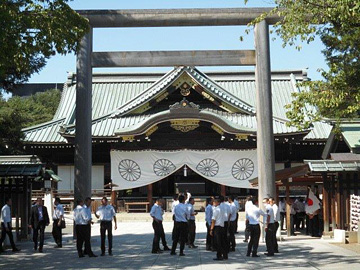
Shinto temple, Tokyo

Monday, September 16: Up at 4:45 am to get to the airport for a 7:30 am flight to Newark, en route for Tokyo. Barry Chaim picked us up and drove us there, giving us last-minute instructions about our trip that he has arranged. Checking in for our United Airlines flight to Newark, we learn that the flight has left. It was rescheduled an an hour earlier. They said we were sent an email but I don’t recall having received it. After much time spent on the phone with Aeroplan, we are rebooked on Air Canada direct to Tokyo which suited us just fine. However, just heard that typhoon Man-yi closed Tokyo airport yesterday!
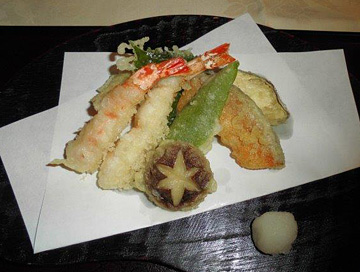
Tuesday, September 17: After a thirteen-hour flight, we arrived in Tokyo to find little evidence of a typhoon. We cleared immigration and customs remarkably quickly and bought tickets for the limo shuttle to ANA Intercontinental Hotel. Our luggage was efficiently packed onto the bus and the guy came aboard as we were about to leave and bowed to everyone. An hour and fifteen minutes later we arrived at the hotel. We united with our travelling companions, Lola and Bob and Leslie and Jonathon for dinner in one of the hotel’s three restaurants, Karin’s. We all ordered soup – mine, abalone and dried scallop – and shared portions of steamed prawn and pork dumplings. To bed at 9:30 pm, exhausted.

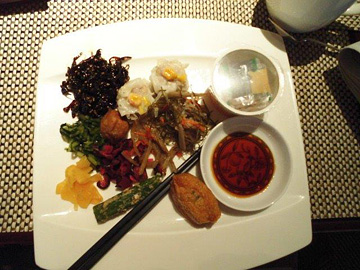
Wednesday, September 18: Awake at 4 am. Breakfast in the hotel, an amazing array of food. Opted for a Japanese breakfast.

My traditional Japanese breakfast

Our Tokyo guide Hitomi

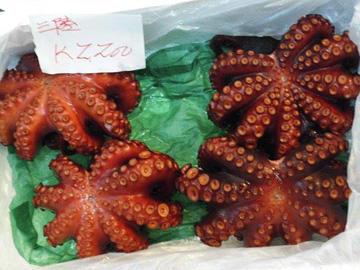
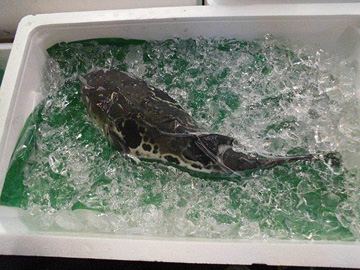
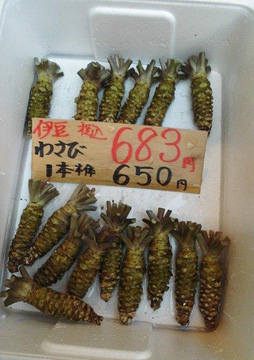
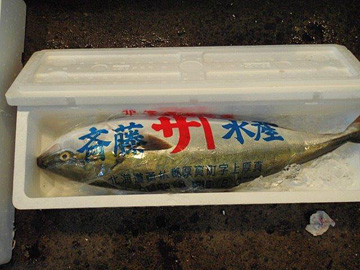
This morning, guided by Hitomi, the daughter of Edo’s first chef, and Kimio Nonaga, Japan’s Iron Chef in 2002, we visited the Tokyo fish market, a vast covered warehouse spreading over 50 acres with more varieties of fish than I have ever seen. Remarkably clean, although you have to be careful of the motorized flatbeds that whizz around the place. Apparently the market is to be torn down to make way for condo development and will be moved to an island off the city. What a shame.

Iron Chef Kimio selecting fish

Market fishmonger
Market fishmonger

Squid
Squid

Blowfish
Blowfish

Fresh wasabi
Fresh wasabi

Prize tuna
Prize tuna

Deborah posing as a tuna fisher

Deborah stopped in at a pottery store to buy four soup bowls before we went to lunch at noon at a Sushi restaurant in Nihonbashi. Enjoyed a Kirin beer with my sushi.

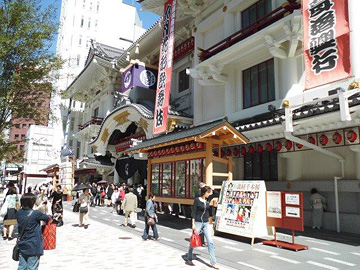
Kabuki Theatre, Tokyo

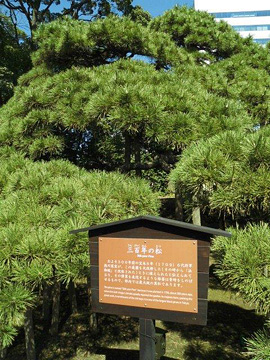
300-year-old fir tree

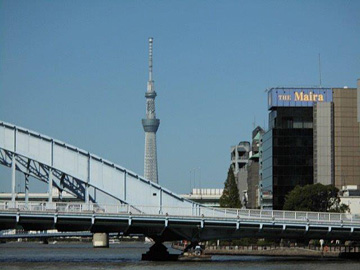
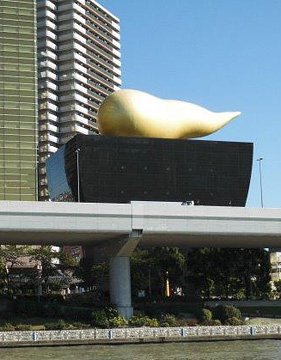
After lunch we took taxis to the Hamarikyu Gardens, formerly the falconry grounds of the Shogun until the mid-seventeenth century. We took a boat trip up the Sumida River to Asakusa. All the bridges across the river are painted in different bright colours. A great way to see Tokyo’s modern architecture, including the Tree of Life and a huge sculpture that looks like a wayward golden sperm.

Tree of Life building

Golden sperm sculpture

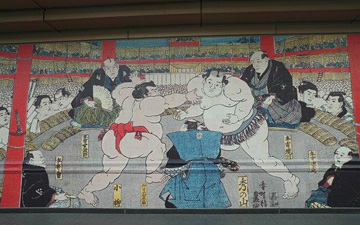
After the boat trip, we took taxis over to the home of sumo in Ryogoku, a stadium to watch only sumo wrestling for six weeks a year. We were crammed, shoeless, into a 5-by-6-foot space, enclosed by a low railing, sitting on square red mats. The most uncomfortable spectator sport in the world. As it is Japan’s national sport, the crowd was the most boisterous and demonstrative I’ve seen by a Japanese audience, who are usually the most reserved and discreet of individuals. Sumo wrestling is a curious sport, very ritualized, with bouts that last only 10 seconds or less. Contestants bow to each other and go through an elaborate dance, slapping their thighs, squatting and lifting their legs and throwing salt into the circular ring to “purify” it of evil spirits. At the end of the final bout the spectators rose and began hurling their mats at the ring. We thought it was because they were unhappy with the result of the match, but it turns out it’s a tradition to chuck your mat at the ring when the tournament is over.

Sumo mural outside stadium

After the sumo wrestling adventure, we cabbed over to Nihonbashi Yukari, to Iron Chef Kimio Nonaga’s restaurant for dinner. His family have been purveyors to the Imperial Family for three generations.

At the restaurant, we were joined by Masayuki Suzuki, a friend of Barry’s who will be our guide tomorrow. And what a meal, not cheap, but one of the finest dinners I’ve had. We started with a bottle of local wine, Adega Aruva 2012, which tasted like a blend of Chardonnay, Sauvignon Blanc and Muscat (the back label was in Japanese).

The first course was a small glass of smoked mozzarella custard, followed by a box with a grass frond laid across the top. Inside were two small pots containing jellyfish and abalone with roasted sesame oil, walnut pate, and on the side, beautifully arranged, a slice of sweet potato, ginkgo nuts and dried fish.

Iron Chef creation
Iron Chef creation

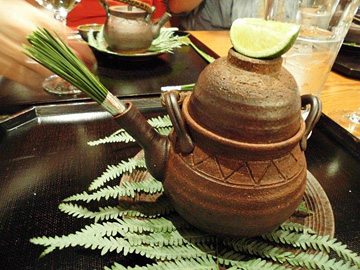
The next course was shiitake mushrooms and pieces of conger eel in a broth served in a pottery teapot with a wedge of lemon and a brush of pine needles wrapped in silver foil stuck into the spout to keep it hot. Masayuki ordered a bottle of Ukari Sake, which we drank at room temperature.

The next course was bonito fish, shrimp, snapper and ark shell with a paste of pickled chrysanthemum petals and shredded daikon and the crunchy, baked head of the shrimp. Next course, leek, tuna, pancake and radish served on a pedestalled plate. Then slivers of waygu beef, followed by Spanish mackerel fish cheeks and rice.

Kimio's rice and fish flake dish
Kimio’s rice and fish flake dish

We finished with adzuki bean ice cream with soya bean flower, brown sugar syrup and crunchy toasted rice grains. Altogether a memorable meal.

The traffic in Tokyo is very disciplined and the drivers are very patient. Haven’t heard one horn yet – not like China, which is chaotic and dangerous.

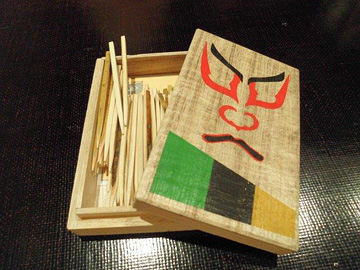
Toothpick holder
Toothpick holder

Thursday, September 18: Had a quick breakfast at Starbucks before meeting Masayuki Suzuki for a walking tour of Tokyo. He showed us how to use the subway system, which is immaculately clean and efficient.

We first visited the Yasukuni Shrine, dedicated to the victims of both side of the civil war, and a museum commemorating the fallen in World War II. We walked over to an district that specializes in second-hand books and woodblock prints. At Kimio Koketsu’s Ohya-Shobo store we saw prints dating back to the eighteenth century.

Walked up to the Hilltop Hotel for lunch at a tempura restaurant. I had a bowl of rice with tempura-battered shrimps and miso soup with baby clams. Then we took the train to Akihabara to visit an amazing electronics department store on five floors.

MaiDreamin Girl
MaiDreamin Girl

As we were walking around we were accosted on one corner by a girl dressed in a French maid’s outfit and carrying a black umbrella to protect herself from the sun. She was handing out leaflets to get you to visit MaiDreamin, where the young girls dress up as French maids and serve you drinks and sing and dance. This, explained Masayuki, was part of the Manga comic book culture of doll-like girls who are as familiar as Disney characters to the young people of Japan. So we decided to check it out. The girl who handed us the flier led us to a building and up some narrow stairs to a room that looked like a junior school room painted in kindergarten colours. Apart from the 1000 yen entrance we had to buy at least two items from the food and drinks menu. We were not allowed to photograph the girls in their short skirts and black stockings but you could choose one with whom we could have your Polaroid photo taken. It was all very weird and vaguely pornographic.

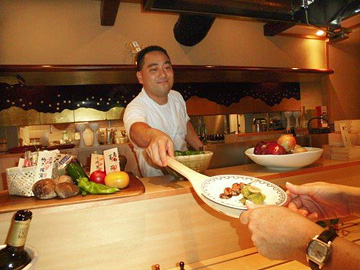
Dinner that evening at the restaurant of Kimio Nogano’s brother Jiro in Kagurazaka. It’s called an izakaya (sake house), which is in effect a Japanese pub. The difference between this one and others, Barry Chaim emailed me, is that “Jiro is a bit upscale and specializes in robata. Robata is the paddle used to put the food on that the cook passes to you. The cooking is usually done on an open grill. The concept originated in the countryside.”

Jiro with gift
Jiro with gift

The menu, which kept on coming: the first dish (cold), a plate consisting of a piece of marinated squash, fish eggs compressed into a short bar, rice roll with fried shrimp, avocado, enoki and oyster mushrooms, seaweed and spinach which we consumed with Reisen Sake. Next, a soup of shiitake mushrooms, conger eel and egg tofu. Followed by raw tuna, amberjack, flounder and bonito flakes.

Jiro with robata dish of eels

Then came the robata dishes: a skewer of grilled eel in a sweet marinade and green pepper stuffed with gorgonzola. A dish of eggplant with finely chopped chicken in miso, mirin and soy sauce. Then a skewer of grilled chicken dusted with salt and sugar and interspersed with leeks. Next tempura of lotus root, sweet potato, chili pepper and conger eel. Followed by fried fish flakes with rice, pickled daikon and ginger. Ending with miso soup and an ice cream and rice flour dumpling, gelatined agar, molasses syrup and toasted rice kernels. And then tea. Home by 11 pm to pack, as we are leaving early tomorrow.

Friday, September 20: Up at 5:30 am to finish packing and be ready to take taxis to the railway station by 6:45 am. We buy a bento box at the station for breakfast before boarding the Nozomi speed train to Kyoto – a journey of 2 hours and 20 minutes. Manage to sleep for an hour. At Kyoto station we buy another bento box for lunch to be eaten when we reach our destination – a ryokan in Ohara, a half hour taxi-ride from Kyoto.

Bento box selection, Kyoto

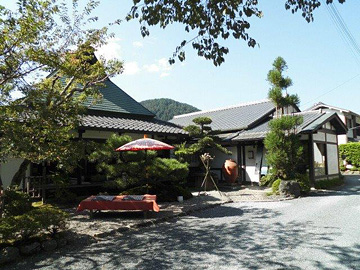
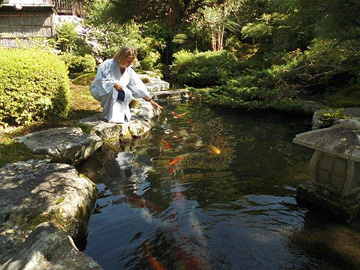
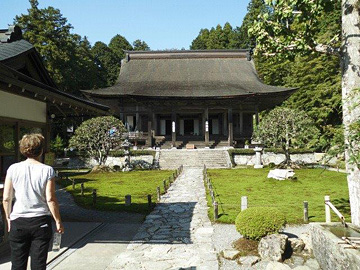
A ryokan is a traditional Japanese inn with tatami-matted floors and sliding door panels – a sort of Japanese B&B. This one, in the hills above Kyoto, is owned by Rieko Nishikawa and her husband Thomas Aoyagi, an ex-Torontonian. Ryokan Seryo, located in front of the Sanzen-in Temple, has been in Rieko’s family for six generations and was originally a tea plantation. Our room opens onto an ornamental pond filled with colourful, fat koi that respond to anyone approaching with open mouths.

Seryo Ryokan
Seryo Ryokan

Our room at the ryokan

Deborah with koi
Deborah with koi

Sanzen-in Temple near our ryokan

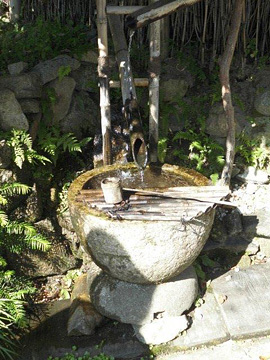
Water fountain, Ohara

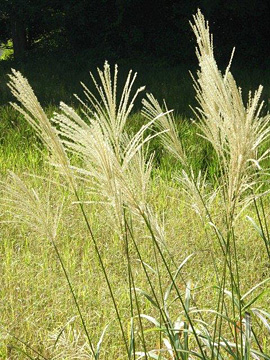
Local flora
Local flora

Local flora
Local flora

We went for a walk around the village and then had a hot mineral bath before dinner. The dinner, served at 6 pm, was a traditional kaiseki multi-course banquet, usually part of the tea ceremony. We ordered a bottle of Saint Clair Sauvignon Blanc 2012 from Marlborough. The first course was a tray with an egg-cup of basil-infused sake the colour of pomegranate, a tiny bowl of marinated aubergine, and a plate of raw salmon and squid. Alongside it was an elevated bowl of traditional one-bite morsels of food for the new moon “from the mountain from the village and from the sea” – okra, potato, fish, crystallized lime and an orange ball to represent the moon.

New moon food
New moon food

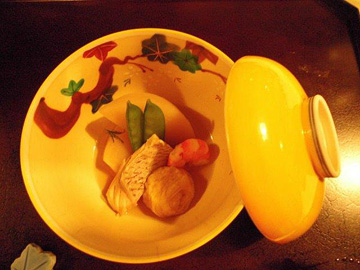
Bream in yellow bowl

This was followed by bream, turnip and tofu in a beautiful yellow bowl. Next, a fresh water fish served on a slate that looked like a sardine stuffed with roe and shaped as if it was swimming in the river.

Freshwater fish
Freshwater fish

Then eel in egg custard followed by shredded chicken and fish salad in a beautifully decorated glass with daikon, cubes of tomato and agar. Next course, tempura of shrimp, squash, green pepper, aubergine and kampio, followed by rice with mushrooms and pickled vegetables and finally miso soup and tea. We were in bed by 8:30 pm!

Tempura
Tempura

Posted in Uncategorized, Wine Lover's Diary | 1 Comment