



Tuesday, September 20th: Cleaned up my desk in preparation for the flight to Florence (via Frankfurt) to celebrate the 300th anniversary of the Chianti Classico denomination. An uneventful flight to Frankfurt except I was wedged between two guys who elbowed me all night. Watched a dreadful Russell Crowe comedy thriller; every second word was an f-bomb. Even from the child actress.
A four-and-a-half-hour lay-over in Frankfurt. Arrived to 9 Celsius weather in Florence though the sun was shining. Caterina from the Consorzio Vino Chianti Classico met me at the airport and drove me to my hotel, Starhotels Michelangelo on Viale Fratelli Rosselli, which will be my home for the next week. Slept for an hour, established email contact with the world and walked a couple of miles from the hotel to San Lorenzo Basilica, looking for two restaurants that had been recommended. Couldn’t find either so I took a chance on Antica Sosta degli Aldobrandini. Lucked into Happy Hour where for 8 euros you get a six-ounce glass of drinkable Chianti and as many tapas as you want. That, and a pistachio ice cream on the way home, was dinner.
Early to bed because I’m being met at 8:45 am to begin touring wineries. (Somewhere along the line today I lost my favourite ball cap. It used to be Burgundy colour but is now bleached pink by the sun. I held a moment of silence for it.)
Wednesday, September 21st: Silvia Fiorentini, Marketing and Communications Manager for the Consorzio, picked me up after breakfast in her chocolate brown Mercedes, which she drives like Fangio through the hellish traffic of Florence. Our first stop is Fontodi in Panzano in Chianti on a beautiful sunny day. Owner and winemaker Giovanni Manetti drives us into the vineyard to see the Sangiovese grapes, which they are beginning to harvest today.
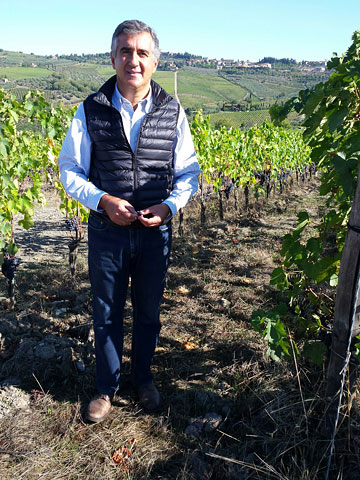
Giovanni Manetti in Fontodi’s vineyard

Panzano, he tells me, is the first district in Italy to go organic. His family have been in the terra cotta tile business since 1650. Given the number of red roofs in the province it must be a great business to be in. Fontodi produces about 30,000 bottles, including a Pinot Nero. “I’m one of the two crazy guys making Pinot Noir in Tuscany,” he says.
- Fontodi Pinot Nero 2014: ruby colour, floral, red berry fruit and oak spice with notes of apricot and barnyard on the nose; medium-bodied, dry, elegant and firmly structured with lively acidity, Tight at the moment. (89–91)
- Fontodi Pinot Nero 2001: mature ruby colour; intriguing mature, savoury nose of raspberries and barnyard notes; medium-bodied, dry, savoury with smoke, tar and leather flavours; very intense yet elegant with ripe tannins. (92)
- Fontodi Chianti Classico 2013: deep ruby colour; a complex nose of rose petals, licorice, cherry and apricot; medium-bodied, dry, elegant, beautifully balanced with lively acidity and a firm finish. (90)
- Fontodi Chianti Classico 2005: mature ruby colour; earthy, licorice and cherry bouquet; medium-bodied, dry, elegant and harmonious, firmly structured with a savoury finish. (91)
- Fontodi Chianti Classico Vigna del Sorba Gran Selezione 2012: dense purple-ruby colour; spicy, cedary, black cherry nose with a mineral note; medium-bodied, dry, rich and full on the palate with ripe, grainy tannins. Powerful but elegant. (92)
- Fontodi Flaccianello delle Piave 2006 (100% Sangiovese): deep purple colour; black cherry nose with spicy oak and undergrowth notes; medium-bodied, dry and savoury, black cherry flavor; firmly structured, full and rich in the mouth with evident but supple tannins and lively acidity. Still youthful. (92–94)


Our next stop is Isole e Olena in Barberino Val d’Elsa. My old friend Paolo di Marchi greets me and tells me that another old friend is there – his English importer, David Gleave. We sit down to a tasting and Paolo outlines his winemaking philosophy. A great wine is like a pentagon, he affirms: you need each side to give the wine harmony – soil at the base, climate and structure at the sides, and the “roof” is the human aspects – the winemaker and tradition (the accumulation of knowledge from past generations). Interesting analogy.

Paolo di Marchi at Isole e Olena
- Isole e Olena Collezione Privata Chardonnay 2014: golden straw colour; spicy, tropical fruit nose with leesy notes; rich and full on the palate, spicy, minerally, pineapple and peach flavours; beautifully balanced with mouth-freshening acidity and great length. Very New World in style and reminiscent of Antinori Cervara della Sala. (Would love to taste those two side by side.) (92)
- Isole e Olena Chianti Classico 2014 (15% Canaiolo and Syrah): ruby colour; spicy, cherry and blackcurrant aromas with pencil lead and animal notes; medium-bodied, dry, lean and sinewy with cherry and redcurrant flavours; well-integrated oak, elegant finishing with peppery tannins. (90)
- Isole e Olena Cepparello 2013 (100% Sangiovese): deep ruby colour; spicy, cherry with oak notes; medium-bodied, dry, savoury, sour cherry flavor with well-integrated oak; firmly structured with a notes of violets on the finish. Hold 3–5 years. (90–91)
- Isole e Olena Cepparello 2010: deep purple-ruby colour; spicy, barnyard and cherry bouquet; medium-bodied, dry, elegant and firmly structured with great length; lovely mouth-feel with resolved tannins and an engaging floral and apple peel finish. (91)
- Isole e Olena Chianti Classico Gran Selezione 2006 (12% Cabernet Franc and 8% Syrah): deep purple-ruby colour; a nose of cherries and oak spice with floral and animal notes; richly extracted cherry flavor, concentrated and fleshy but firm; very youthful still with grainy tannins. A magnificent wine. (94)
- Isole e Olena Collezione Privata Syrah 2014 (2% Viognier): dense purple colour; spicy blackberry and sweet herbs on the nose with a mineral thread; full-bodied, dry, blackberry, blackcurrant and bay leaf flavours, firmly structured, finishing on a floral note. (93)
- Isole e Olena Vin Santo del Chianti Classico 2006: tawny-amber colour; dried fig and honey on the nse; full-bodied, richly extracted, sweet honey and dried fig flavours carried on brisk acidity to give great length. (93)
Silvia took me to lunch at Locanda di Pietracupa in San Donato in Poggio. We both ordered the same dishes: Tagliolini fiori di zucca e tartufo (homemade thinner tagliatelle with courgette flowers, topped with fresh truffle) and grilled chicken salad. I had a glass of Tenute del Cerro Vermentino 2014.
After a visit to the Chianti Classico Consorzio office, I was dropped off at Antinori in Chianti Classico’s extraordinary new winery in Bargino, San Casciano Val di Pesa.

Entrance to Antinori in Chianti Classico
I watched a movie about the construction of the building as I waited for my guide, Sara Nieddu. It was subtitled, “5 Years in 15 Minutes.” I saw it three times. Sara was full of apologies as there had been a mix-up about my visit. But it was worth the wait. The building is a cathedral to Dionysus. After a tour and a film on winemaking we sat in a glassed-in tasting room that’s cantilevered out over the barrel cellar.
- Antinori Peppoli Chianti Classico 2014 (10% Merlot and Syrah): ruby colour; cedary, earthy, cherry nose; medium-bodied, dry, sour cherry flavor with lively acidity; fresh, fruity and easy drinking. (88)
- Villa Antinori Chianti Classico Riserva 2012 (10% Cabernet Sauvignon): ruby colour; cedary, black cherry and pencil lead nose with sweet herbs and vanilla oak notes; medium-bodied, dry, savoury cherry flavor with well-integrated oak. (90)
- Badia a Passignano Gran Selezione 2011 (100% Sangiovese): deep ruby colour; spicy, leather, dried rose petals, cherry and oak nose; medium to full-bodied, dry with a sweetness of ripe cherries and plum at the core; well-balanced and harmonious and firmly structured. (91)
A taxi took me back to Florence, a hair-raising drive through the Tuscan hills at speed as there was an accident on the motorway that held up traffic for three kilometers. Once back I walked over towards the railway station looking for a shop where I could buy a jacket. In my haste to leave Toronto I forgot to pack one and there is a formal dinner on Saturday. On the way back to the hotel I picked up an egg and tomato sandwich, which is all I could eat after that big lunch.
Friday, September 23rd: Caterina picked me up in her Fiat to drive to Felsina in Castelnouvo Berardenga, the most southerly winery in the Chianti Classico appellation. She was delayed because of the traffic and her seat belt sensor wasn’t working properly which meant the alarm kept going off. The only way to stop it was to hold it firmly in place – which she did on the motorway in spite of my offers to help.
We were an hour late arriving at Felsina so Giovanni Poggali had to brief me quickly before the tasting and the tour of the cellars. His grandfather bought the 500-hectare estate in 1966. There were 6 hectares of vines planted then; now there are 65 hectares under vine, 80% Sangiovese with Pinot Noir, Cabernet Sauvignon, Cabernet Franc, Merlot, Chardonnay and Sauvignon Blanc. Also Malvasia and Trebbiano for Vin Santo. Felsina produces 450,000 bottles.
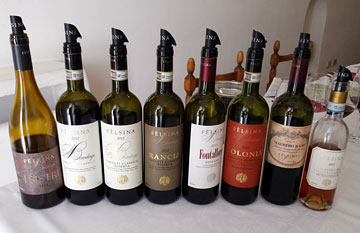
Tasting at Felsina

- Felsina Issistri Chardonnay 2013: golden straw colour; rich apple and oak spice nose; full-bodied, dry, apple and caramel flavours; good length. (89)
- Felsina Chianti Classico Berardenga 2013: deep ruby colour; cedary, black cherry nose with a floral note; medium-bodied, richly extracted, cherry and dark chocolate flavours with well-integrated oak. (90)
- Felsina Chianti Classico Riserva Berardenga 2012: deep ruby with a mature rim; cedary, cherry with a note of vanilla oak; medium-bodied, dry and savoury, elegant, well-balanced. (91)
- Felsina Rancia Chianti Classico Riserva 2012: deep ruby colour rich, ripe floral nose, cherry with lead pencil notes; medium-bodied, dry, well-extracted cherry and dark chocolate flavours with supple tannins. (92)
- Felsina Fontalloro 2012 (100% Sangiovese from three vineyards, two in Colli Senesi and one in Chianti Classico; 2 years in new French oak): dense ruby colour; cedary, cherry with a savoury-herbal notes; medium to full-bodied, dry, savoury, cherry flavor with evident but supple tannins. (91)
- Felsina Berardenga Colonia Chianti Classico Gran Selezione 2010: deep ruby colour; spicy, plum and cherry nose with vanilla oak notes on the nose; medium-bodied, dry, herbal, cherry and plum flavours, backed by vanilla oak; dusty, grainy tannins on the savoury finish. (90)
- Felsina Maesta Raro Cabernet Sauvignon di Toscana 2012 (100% Cabernet Sauvignon aged 18 months in new French barrique): dense ruby-purple colour; cedary, plum and blackcurrant nose with vanilla oak notes; medium to full-bodied, dry, blackcurrant and dark chocolate flavours; well-balanced and firm with evident tannins. Hold 5 years (90–92)
- Felsina Vin Santo del Chianti Classico 2005 (Sangiovese, Malvasia and Trebbiano): deep amber colour; dried fig, barley sugar bouquet; full-bodied, rich and full on the palate with flavours of caramel and orange. Beautifully balanced with fresh acidity. Great length. (94)
Next we drove to Badia a Coltibuono in Gaiole in Chianti, a monastery founded in 1051, now a 3-star hotel and restaurant. Their grapes are grown in Monti and the wines are made here.

Badia a Coltibuono
Winemaker and estate manager Roberto Stucchi Prinetti showed us around. The hall that the monks used to dine in is decorated with frescoes beautifully restored. Toured the 18th-century cellar where the family keeps its private library of vintages dating back to 1937.

Badia a Coltibuono’s Roberto Stucchi Prinetti
- Coltibuono Cetamura Chianti 2015 (Colli Senesi): deep ruby colour; cherry and leather on the nose with a herbal note; medium-bodied, dry and fruity with a firm tannic finish. Easy drinking. (87)
- Coltibuono Chianti Classico 2014: ruby colour; earthy, spicy, cherry and red plum nose; medium-bodied, dry, fresh with lively acidity and a tannic uplift on the finish. (88)
- Badia a Coltibuono Chianti Classico 2014 (10% Canaiolo, Colorino and Cigiegiolo): ruby colour, spicy, cherry with a light oak note; medium-bodied, dry, elegant, firmly structured with ripe, dusty tannins on the finish with a cherry pit finish and a light floral note. (89)
- Badia a Coltibuono Chianti Classico Riserva 2011: deep ruby colour; leather, cherry, floral-savoury notes on the nose; medium-bodied, dry, elegant, sour cherry and licorice flavours; firmly structured with evident but ripe tannins. Still young, needs five years at least. (90–92)
- Badia a Coltibuono Cultus Boni Chianti Classico Riserva 2011 (80% Sangiovese with eight indigenous varieties): deep ruby, earthy, cherry with leather and herbal notes; medium to full-bodied, dry, richly extracted, full in the mouth with cherry and plum flavours backed by lively acidity and a firm tannic structure. (90)
- Badia a Coltibuono Sangioveto di Toscana 2011 (100% Sangiovese): deep ruby colour; spicy, earthy, plum and cherry nose with oak notes on the nose; full-bodied, dry, plum and cherry flavours with well-integrated oak. Lovely mouth-feel. Firm finish. (91)
- Badia a Coltibuono Montebello 2011 (nine indigenous varieties): deep ruby colour; majestic, spicy, creamy, cherry and sweet herbs on the nose; medium-bodied, elegant, beautifully balanced and firm; lovely mouth-feel with a floral note on the finish. (92)
- Badia a Coltibuono Vin Santo del Chianti Classico 2009: coppery-amber colour; spicy, dried fig, macadamia nut nose with a note of dried flowers; full-bodied, rich, unctuous and full on the palate with nutty, spicy, orange and jasmine tea flavours. Great length. (95)
Lunched in the winery’s restaurant. Roberto opened a bottle of Badia a Coltibuono Chianti Classico Riserva 2006. I ordered risotto with lard and onion, which looked and tasted a lot better than the menu description.


Risotto at Badia a Coltibuono
The final stop of the day was at Agricola Querciabella. The winery has 75 hectares of vineyard in the Chianti Classico region and a further 31 hectares in Maremma. South African winemaker Manfred Ing showed me the winery and opened the following wines.

Winemaker Manfred Ing at Querciabella
- Querciabella Chianti Classico 2013 (100% Sangiovese): ruby colour; cedary, cherry nose with minerally, pencil notes; medium-bodied, dry, sour cherry flavour, lively acidity with a firm tannic structure. Needs 5 years. (89–91)
- Querciabella Chianti Classico 2007 (5% Cabernet Sauvignon): ruby colour with a mature rim; spicy, tobacco, cherry with a light floral note on the nose; medium-bodied, dry, cherry with a savoury note; well-structured, fresh and lively with a firm finish. (91)
- Querciabella Chianti Classico 1998 (5% Cabernet Sauvignon): mature ruby colour; earthy, tobacco, cherry bouquet nose with a note of dried flowers; medium-bodied, dry, elegant, savoury, cherry flavor. (91)
- Querciabella Chianti Classico Riserva 2011 (100% Sangiovese): medium ruby colour; minerally, spicy, cherry nose; medium-bodied, dry, elegant, savoury-herbal; great mid-palate depth with a firm tannic finish. (92)
- Querciabella Chianti Classico Riserva 1999 (10% Cabernet Sauvignon): mature ruby colour; tobacco, floral, cherry and blackcurrant nose; medium-bodied, dry, elegant, beautifully balanced with ripe tannins. Almost claret-like. (92)
- Querciabella Camartina 2010 (70% Cabernet Sauvignon, 30% Sangiovese): deep ruby colour; cedary, blackcurrant and cherry nose with a tobacco note; medium-bodied, dry, red and blackcurrant flavours with chewy tannins and a truffle note on the finish. (91)
- Querciabella Camartina 1999 (30% Cabernet Sauvignon, 70%Sangiovese): mature ruby colour; cedary, blackcurrant, spicy nose; medium-bodied, elegant, dry, savoury, firmly structured, currant and tobacco flavours with great length. (92)
- Querciabella Batár 1998 (50% Chardonnay, 50% Pinot Bianco): old gold colour; caramel, toasty nose; rich and mouth-filling, caramel, baked apple and pear flavours with great length and balancing acidity, finishing on a dry barley sugar note. (91)
- Querciabella Batár 2013 (50% Chardonnay, 50% Pinot Bianco): straw colour; spicy, apple with a light oak note; medium to full-bodied, dry, elegant, apple and pear flavours; lovely mouth-feel, well-integrated oak, fine acidity with great length. (92)
We drove back to Florence and I was back in the hotel by 7:30, a long but productive day.
Saturday, September 24th: Today is actually the 300th birthday of the decree by Cosimo III of Tuscany designating the four growing zones of Chianti – Chianti Classico, Pomina/Chianti Rufina, Carmignano (where Cabernet Sauvignon has been grown since the 16th century) and Valdarno di Sopra.
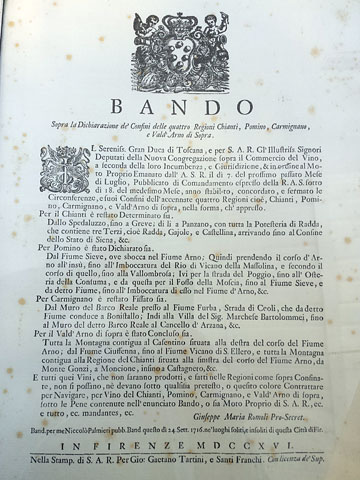
The 1716 decree demarcating the four Chianti Classico communes
The formal address was held in Palazzo Vecchio, a stunningly beautiful hall with painted walls and ceilings (Michelangelo’s statue of David is outside).

Palazzo Vecchio in Florence
The cities of Reims and Florence have been twinned since 1954 and now there is a more formal cooperation agreement under way although no details were given.

Doorbells, Florence
Our party had lunch in a restaurant called The Golden View (which provides the best view of the Ponte Vecchio over the River Arno). On the table were bottles of Rocca delle Macie Chianti Classico Riserva di Fizzano 2013, Isole e Olena Chianti Classico 2006, Felsina Francia Chianti Classico 2012, Capanelle Chianti Classico Riserva 2012 and Castello Monsanto Chianti Classico 2014.
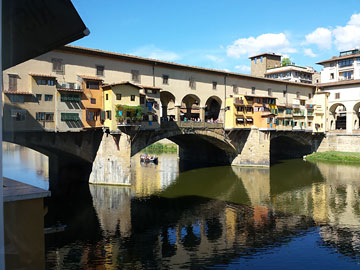
Ponte Vecchio, Florence
Then I went in search of a tie, which I bought at a stall in the market for 6 euros (but it looks great). Back to the Opera de Firenze for more talk about the 300th anniversary. Italy’s youthful Prime Minister, Matteo Renzi, spoke about the need to compete with the French for the international wine market, and the seven mayors from the cities in Chianti Classico signed a document ratifying an agreement to apply to UNESCO to have Chianti Classico made a World Heritage site. This was followed by a concert of opera selections by a 72-voice choir with arias be a soprano and a tenor (gorgeous). Then a sit-down dinner for 750 people – great menu with wines by Monsanto and Isole e Olena (Paolo Marchi and his wife were at our table, also Laura Monsanto from Castello Monsanto as well as Stephen Spurrier).

Dinner menu
We were invited to take dessert and drinks on the concourse outside the opera house and were surprised by a fireworks display.

Birthday fireworks

Sunday, September 25th: Walked to Palazzo Strozzi to buy some gifts in the outdoor market and then back to meet Janine Saine, a wine writer colleague from Quebec, to walk to Piazza d. Mercato Centrale for lunch in a small open restaurant, Enoteca Chianti Classico, that offers 200 Chianti Classico labels for sale as wine from other Italian provinces. Had a plate of antipasti with glasses of Rocca di Montegrossi Chianti Classico 2013 and Bindi Sergardi Chianti Classico La Ghirlanda 2013. I was so impressed by the latter that I bought a bottle of Bindi Sergardi Chianti Classico Caledonia Riserva 2013 at the restaurant.

Janine and I went on to a public tasting in the crypt of the Basilica di San Lorenzo – 100 wines set out on tables representing the four Chianti zones. I tasted the following wines: Capezzana Trefiano Carmignano 2010, Tenuta di Artiminio Carmignano Riserva 2012, Villa di Capezzana Carmignano 2013, Farbrizio Gratesi Il Circo Rosso Carrmignano Riserva 2013; from Valdarno di Sopra, Castello di Montozzi Sangiovese Riserva 2013, Tenuta Sette Ponti Vigna dell Impero 2013, Nunzi Conti Chianti Classico 2013, Villa S. Andrea Chianti Classico Riserva 2010, Castello di Abola Chianti Classico Gran Selezione 2013, Castello Trebbio Lastricato Chianti Classico Riserva 2011 and finally, from Rufina, Frescobaldi Nipozzano Vecchia Viti Chianti Rufina 2013. On our way back to the hotel we wandered through the San Lorenzo outdoor market and I bought a navy blue leather belt.

Wall art, Florence
In the evening I met up with Steven Spurrier, Barbara Philip and Janine for dinner. We dropped into an amazing wine bar – Le Volpi e l’Uva, Piazza dei Rossi, at the southern end of Ponte Vecchio. We ordered a glass of wine and a plate of salami and olives. The owner Leonardo, when he learned we were wine people, insisted on us blind-tasting three wines – Olivier Champion Jasinères Les Clos 2015, Sarno 1860 Fiano de Avelino (couldn’t find the vintage) and Château des Rontets Pouilly-Fuissé Clos Varambon 2014. Confession: we failed rather ignominiously.

Tuscan antipasto
Then on to dinner at Cammillo Trattoria, Borgo S. Jacopo 57. A small, noisy trattoria with great food. I ordered rocket salad with pine nuts and parmesan and ricotta cheese and chard gnocchi in butter and sage sauce. The wines: Rocca di Montegressi Chianti Classico 2013, Moris Farm Morellino di Scansano 2011 and a small carafe of house wine.
Monday, September 26th: Three winery visits today. Silvia Fiorentini drove Janine and me to Fonterutoli in Panzo in Chianti. Filippo Mazzei toured us around the spectacular cellar (beautifully designed by his architect sister) and led us through the tasting.
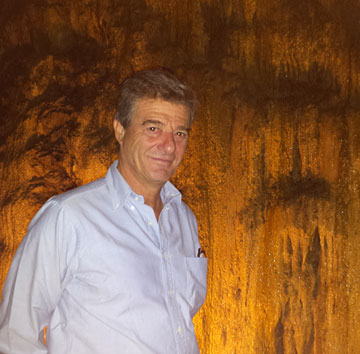
Fonterutoli’s Filippo Mazzei

- Fonterutoli Chianti Classico 2014: dense ruby colour; cedary, black cherry with a light floral note; medium-bodied, dry, elegant, well-extracted black cherry flavor with a lively spine of acidity. (91)
- Fonterutoli Ser Lato Chianti Classico 2013: deep ruby colour; earthy, savoury-herbal, black cherry bouquet; medium-bodied, dry, full in the mouth, well integrated oak with ripe tannins. (90)
- Castello Fonterutoli Gran Selezione 2012: ruby with a tawny rim; black cherry, evident oak with a pencil lead note on the nose; medium-bodied, dry, lean and sinewy with a sour cherry flavor. (90)
- Castello Fonterutoli Mix 36 2012 (all 36 clones of Sangiovese): deep ruby colour; cedary, cherry with a note of dried herbs on the nose; medium-bodied, dry, sour cherry flavour with lively acidity. (89)
- Fonterutoli Siepi 2013 (50% Sangiovese, 50% Merlot): dense ruby colour; cedary, black cherry and blueberry nose with a light floral note; medium-bodied, dry, well-structured with ripe grainy tannins on the finish. (90)
- Fonterutoli Chianti Classico 2009: deep ruby developing a tawny rim; cedary, leather, cherry nose with an animal note; medium-bodied, well-extracted plum and cherry flavours. Ready now. (92)
- Fonterutoli Chianti Classico 2004: dense ruby with a tawny hue; mature, cedary, spicy plum and cherry nose; medium to full-bodied, with sweet fruit still firm with ripe tannins. (92)
- Castello Fonterutoli Chianti Classico 2010: deep ruby colour; cedary, cherry, spicy nose with a note of oak; richly extracted, beautifully balanced.

Next stop: Dievole in Vagliagli, which we approached on a bumpy, unpaved road. Manuela Neideracher, the brand manager, toured us around the property and the oenologist conducted the tasting.
- Dievole Chianti Classico 2013: ruby colour; cedary, cherry, with light oak bouquet; medium-bodied, dry and savoury with a firm tannic finish. Somewhat acidic. (87)
- Dievole Chianti Classico 2014: ruby colour; spicy, plum and cherry with pencil lead and animal note; well-extracted, medium-bodied, dry, firmly structured, earthy with ripe tannins. (88)
- Dievole Chianti Classico Novecento Riserva 2013: deep plum colour; vanilla oak, cedar, cherry nose; medium-bodied, dry, elegant, red plum and cherry flavours; firmly structured. (89)

The chapel at Dievole

Followed by an olive oil tasting of three different Dievole oils – one of which was judged “the best olive oil in the world.” We had lunch under a tree in the garden with a delightful rosé, Dievole Roriziosato Le Due Arbie 2015. I ordered mozzarella and tomato salad and pici pesto. Brizio Rosso di Montalcino 2014 and Podero Brizio Brunello di Montalcino 2011. Vin Santo and cartucchi for dessert.

The world’s best olive oil
Our final stop was at Castello di Volpaia in Radda, a winery I know well since I’ve visited it four times, including staying in the hamlet for a couple of nights on my honeymoon in 1997. Giovannella Mascheroni Stianti and her daughter Federica gave us a wonderful welcome. We tasted in Giovannella’s house.

Door at Castello di Volpaia
- Castello di Volpaia Vino Spumante 2008 (Sangiovese): pale straw, white peach and citrus nose; medium-bodied, dry, peach with citrus, crisp and fresh with a firm finish. (89)
- Castello di Volpaia Vermentino 2015 (Maremma): straw colour; earthy, yellow plum; medium-bodied, dry, peach and plum flavours with a saline note, well-balanced, with a touch of bitterness on the finish. (88)
- Castello di Volpaia Chianti Classico 2014 (10% Merlot): deep ruby colour; cherry, leather, cedar nose; medium-bodied, dry, savoury cherry flavour; firmly structured with lively acidity and evident but ripe tannins. (88.5)
- Castello di Volpaia Chianti Classico Riserva 2013: deep ruby colour; cherry, vanilla oak, spicy, note of leather on the nose; medium-bodied, dry, elegant, savoury, cherry with a light floral note; finishing firmly. (89)
- Castello di Volpaia Chianti Classico Coltassala 2013 (5% Mammelo): deep ruby colour; earthy, cherry, cedary, leather nose with a light floral note; medium-bodied, dry, sour cherry and plum flavours with well-integrated oak with a firm finish. (89)
- Castello di Volpaia Chianti Classico Casanova Il Puro Gran Selezione 2011 (25 clones of Sangiovese): deep ruby; rich and porty on the nose with new oak notes; full-bodied, raisiny, plum with lively acidity, firmly structured with a tannic lift on the finish. (90)
- Castello di Volpaia Balifico 2012 (2/3 Sangiovese, 1/3 Cabernet Sauvignon): deep ruby-purple colour; cedary, spicy, blackcurrant and black cherry nose; medium-bodied, dry, elegant, beautifully balanced, firmly structured, ripe blackcurrant and plum flavours, richly extracted with a firm tannic finish. (91)

Church at Volpaia
Drove back to Florence, changed quickly in the hotel and walked over with Janine to have dinner at The Golden View Restaurant with the director general of the Consorzio Vino Chianti Classico, Giuseppe Liberatore, Silvia Fiorentini, Christine Lechner (Marketing & Communications), and Justin Leone, chef/sommelier at Tantris restaurant in Munich. We started with a bottle of Guado al Tasso Vermentino 2013 (excellent – 91points). And it got better – next wine, Monteraponi Chianti Classico Riserva Baron’ Ugo 2011 (mature ruby colour; a nose of leather, cherries and dried rose petals; elegant and beautifully balanced, lovely mouth-feel; reminiscent of a Côte de Nuits (95)).

Followed by Isole e Olena Cepparello 1999 (holding its rich ruby colour; a bouquet of cherries and blackcurrants with a tarry note and a touch of barnyard; full-bodied, dry and perfectly balanced, very elegant and rich (94)).

I ordered Carpaccio of Chianina beef and black truffles, followed by seafood spaghetti. For dessert, Castello di Volpaia Vin Santo del Chianti Classico 2011. The last supper in Florence and a great one.

Carpaccio of Chianina beef with black truffles

Tuesday, September 27th: After breakfast, packed for home. Taxied to the airport and flew to Munich to catch my Lufthansa flight to Toronto. No Chianti Classico on board, pity.