

Sunday, March 4: Arrived in Frankfurt on a couple of hours sleep. The meal on Air Canada wasn’t bad for once, chicken in some kind of a sauce. At Frankfurt Airport, ran into Charlie Pillitteri, who is also going to ProWein. Sat next to him on the short flight to Dusseldorf. I was picked up by a courtesy Mercedes and driven to the Nikko Hotel. The room wasn’t ready so I had to shower in the spa before going down to register for ProWein.

This event happens in five different halls covering 43,000 square meters. Fifty countries are represented with 3930 exhibitors. So successful has ProWein become that they say they are adding two more halls next year.

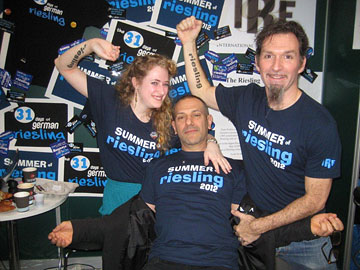
Paul Grieco (bearded) and his Riesling team
Before lunch I stopped by the booth of Bouvay Ladubay Zero (lovely sparkler and peppery Rosé sparkler). Other highlights: Domaine Figeat XXL 2011 (minerally, floral, elegant Fumé Blanc); Weingut Kirchner Freinsheimer Riesling 2011 from the Pfalz (crisp, lemony and clean) and their 2010 Saumagen Riesling Trocken (minerally, salty, grapefruit).
Spent some time tasting the range of Domaine D’en Segur, loved their Grande Réserve 2007 (ruby, minty blackcurrant, dry and elegant) and their off-dry Sauvignon d Or 2011 with 30 grams residual sugar (gooseberry, grapefruit and honey).
At lunch in the Press Room ran into old friends Anthony Rose and Roger Voss. Then back to the floor in Hall 4 for visits to more German booths: Weingut Jürgen Leiner Grauer Burgunder Handwerk Trocken 2011 from the Pfalz – lovely (very elegant, minerally, grapefruit and peach flavours), also his Grauer Burgunder Katzebosch Trocken 2010 from 40 year-old vines (minerally, leesy with a floral note). Also from the Pfalz, Knipser Sauvignon Blanc 2011 (spritzy, light, peapod and grapefruit flavour) and his Grauburgunder Trocken 2011 (spicy, spritzy, minerally and fresh). Finished up at Heitlinger and enjoyed a delicious White 2011 blend of Sylvaner, Riesling, Pinot Blanc and a touch of Gewürztraminer.
Took a taxi back to the hotel and slept for two hours before getting ready to join the group for a dinner at Monkey South restaurant. Eleven producers presented their VDP wines with a variety of passed small dishes. (Unlike the Bordeaux classification, which has remained basically static since 1855, the VDP is reclassified every 5 years.)
- Weingut Schloss Proschwitz Müller-Thurgau trocken 2011 (Sachsen)
- Fürstlich Castell’sches Domänenamt Casteller Hohnart Silvaner Kabinett trocken 2010 (Franken)
- Bürgerspital zum Heiligen Geist Würzburger Stein-Harfe Silvaner Spätlese trocken 2010 (Franken)
- Weingut Balthasar Ress Rüdesheimer Berg Schlossberg Riesling trocken 2010 (Rheingau)
- Weingut Dr. Wehrheim Rotliegendes Riesling S trocken (Pfalz)
- Weingut Baron Knyphausen Hohenrain Riesling Erste Lage 2010 (Rheingau)
- Weingut Pinzsalm Berg Roxheim Riesling Grosses Gewächs trocken 2009 (Nahe)
- Weingut Herbert Messmer Muskateller Feinherb 2011 (Pfalz)
- Weingüter Geheimrat J. Wegler Bernkastel Doctor Riesling Spätlese 2010 (Mosel)
- Weingut Sankt Urbans-Hof Okfener Bockstein Riesling Spätlese 2009 (Mosel-Saar-Ruwer)
- Weingut Fürt Hohenloe Oehringen Verrenberg Lemberger Grosses Gewächs trocken 2009 (Württemberg)
Then a taxi back to the hotel and bed.
Monday, March 5: Up at 7 am. On the bus to the ProWein venue where I spent the morning in search of German Pinot Noir. Stuart Piggott, who lives in Berlin, gave me a list of producers whose booths I should visit. On my way into the hall I passed a booth manned by Paul Greico, a Riesling evangelist who owns Hearth and Terroir wine bar in New York. Paul is responsible for the Summer of Riesling event to promote Riesling in restaurants across the States.
On my Pinot Noir quest (what the Germans call Spätburgunder) I started with Bernhard Huber, whose wines were a revelation, five of the six scoring 90 points or above. Especially liked Huber Bienenberg Spätburgunder 2009 (very rich and mouth-filling with a great mouth feel) and Huber Sommerhalde Spätburgunder 2009 (floral, raspberry nose, very feminine). Huber said to me, “Pinot Noir must be dancing on the tongue.” The best of all was Huber Wildenstein Spätburgunder 2009, from a vineyard first planted 700 years ago (floral-raspberry flavour, lovely mouth feel, great structure, like a Chambolle-Musigny).
Next stop, Weingut Bercher, whose Fenerberg Spätburgunder Grosses Gewachs 2009 was really majestic in its minerality and dry, somewhat austere red berry flavour. At Winzerhof Thörle my top wine of the two I tasted was Hölle Spätburgunder 2009 (elegant, cherry flavour, very Burgundian).
Hans-Bert Espe created his winery in a former ammunition shelter on the Canadian air base at Lahr. He called his enterprise, as a result, Shelter Winery and he makes stunning Pinot Noir. Shelter Winery Spätburgunder 2010 is very elegant and light on the palate, perfumed and poised very much in Volnay style. Even better is his Shelter Winery Pinot Noir 2009 (concentrated and rich raspberry flavour, beautifully balanced with a lovely mouth feel).


Drappier Rosé champagne
On to Weingut Zimmerle for two more. My favourite was Zimmerle Spätburgunder 2009 (very elegant, minerally, beautifully balanced raspberry flavour). After lunch, in search of Weingut Hanspeter Ziereisen, I passed the Drappier stand, which had a Balthazar displayed on the counter. Since this was the wine I had at my wedding (and it was corked) I had to stop by and taste. Michel Drappier (I didn’t tell him the story) offered me a glass of Drappier Rosé Nature, a pink champagne without dosage. Brilliant bubbly with a taste of wild strawberries and lemon.
At 2:30 pm I had arranged to come to the German Wine Institute, where several Pinot Noirs had been gathered. Of the six I tasted I liked the Huber Schlossberg “R” Spätburgunder 2009 (which I had already tasted) best. After this I found Ziereisen’s booth six Pinots and a Syrah. The best wine was Ziereisen Jaspic Pinot Noir 2009 (“jaspic” refers to the flint soil, which gives the wine a smoky, minerally note, very elegant with great balance).
My final Pinot Noir stop was at the booth of Dr. Heger for his Häusleboden Spätburgunder 2008 (firmly structured, floral, elegant). I must have covered about four miles walking the lanes trying to locate the various wineries.
Finally sat down in the Boisset stand with Jean-Charles Boisset and my old friend Lorenzo Dogliani showed up. Jean-Charles was entertaining a buyer for a Russian store chain and insisted we all tasted a series of wines owned by the company: Moreau Chablis Valmur 2009, Boisset Famille Saint-Aubin 2009, JCB No. 21 Crémant de Bourgogne, JCB No. 69 Crémant de Bourgogne, Buena Vista Zinfandel 2010, Buena Vista Pinot Noir Carneros 2009, The Count of Buena Vista 2008 (a field blend of Zinfandel, Syrah, Cabernet Sauvignon and Petite Sirah), Bouchard Aîné Beaune 2009 and Bouchard Aîné Clos de la Roche. Boisset’s cellar master for the Louis Bouillot sparkling wines sat down and showed us four of the 13 Crémant de Bourgogne the company makes. Then I went up to the press office and went on line to read emails before taking the bus at 6 pm back to the hotel. Ate dinner in the hotel bar – a pizza-like dish, thin crust with prosciutto, grated fresh parmesan and rocket with a local draft beer.
Tuesday, March 6: Our last day at ProWein. Visited the Bürgerspital booth to taste their Bürgerspital Würzburg Spätburgunder 2009 from Franken. Pale ruby colour, delicate, minerally, raspberry with a touch of sweetness; carries its 13.5 alcohol very well. Then to the Salwey booth to taste a series of five Spätburgunder. The best was the most expensive, naturally – Salwey Kirchberg Spätburgunder Grosses Gewachs 2009 (pale ruby but the nose and palate belied its colour – powerful , smoky, minerally raspberry flavour, lean and muscular. Picked at 35 hectolitres per hectare).
Next to Batasiolo for a tasting of eight wines. Highlights were Batasiolo Barolo Vigneto Corda della Briccolina 2006 (deep ruby with a brick rim; earthy, licorice and dried cherry nose; elegant, dry, majestic ; still tight. And Batosiolo Bosc DLA REI Moscato d’Asti (straw colour; light, grapey, honeysuckle and orange flavours; elegant and easy drinking. 5.5% alcohol).
Finished the morning with a tasting at Sankt Urbans-Hof with Nik Weis. As we were tasting David Adelsheim dropped by. We went through nine Sankt-Urbans Rieslings. Best wines: Sankt Urbans-Hof Bockstein Ockfen Riesling Kabinett 2011 (minerally, honeyed grapefruit; round on the palate with lilac and smoky notes); Sankt Urbans-Hof Goldtröpfchen Piesport Riesling Kabinett 2010 (pale straw; minerally nose of redcurrants; spritzy, redcurrant and honey flavours, lovely balance) and Sankt Urbans-Hof Bockstein Ockfen Riesling Auslese 2010 (honeyed grapefruit with a floral note; amazing balance of fruit and acidity).
Lunch and then on the bus for two hours to Niederhaus in the Nahe to visit Weingut Jakob Schneider. They own twenty hectares of vineyards in the Nahe. Thirty percent are on slopes of 50 percent. Been in business since 1575. Very attractive pricing. The son of Jakob Schneider, also named Jakob, led us through the tasting.
- 2011 Melaphyr Riesling trocken (melaphyr is a soil type in the region with large proportion of iron): minerally, dry, citrus and tropical fruit, lively acidity, light on the palate (87)
- 2011 Niederhäuser Hermannshöhle Riesling trocken: minerally, apple, floral note; golden apple and citrus flavour with a spicy note (88)
- 2011 Niederhäuser Felsensteyer Riesling trocken: spicy, minerally, grapefruit rind with a leesy note; light spritz, charming, delicate, lovely soft mouth feel, and a good balance of fruit and acidity (89)
- 2011 Norheimer Dellchen Riesling trocken: slatey, minerally, citrus, banana with a floral note; rich, lime, honey, round on the palate; good length (89)
- 2010 Norheimer Dellchen Riesling trocken: minerally, salty, citrus; melon and crab apple flavours, lively acidity, lovely mouth feel, beautifully balanced, with a tangerine finish (90)
- 2010 Niederhäuser Hermannshöhle Riesling trocken Magnus: developing petrol notes, honey, apricot; lush, spicy, orange and peach flavours, full in the mouth; beautifully balanced (90)
- 2011 Niederhäuser Klamm Riesling Kabinett: minerally, honey, leesy; ripe peachy flavour with lively acidity (88). Kabinett is the new Spätlese because of global warming!
- 2011 Niederhäuser Klamm Riesling Spätlese: leesy, tropical fruit with mineral notes, honey; honey, green apple flavours, a little hard on the finish (acidified?) (88)
- 2010 Niederhäuser Hermannshöhle Riesling Spätlese: minerally, honey, peach; spicy, honeyed, pineapple, very elegant; beautifully balanced, great length (91)
- 2011 Niederhäuser Hermannshöhle Riesling Auslese: minerally, honey, peach; not as mouth-filling as the 2010 Spätlese, more delicate, spicy, peach and honey (91)
- 2010 Niederhäuser Hermannshöhle Riesling Auslese Junior: pale colour; sweet and tart, spicy, pineapple and honey, unctuous, concentrated, high acid (not really together yet, brittle finish) (89)
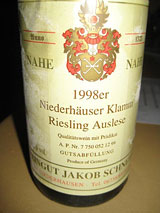
An amazing 1998 Auslese
- 1998 Niederhäuser Klamm Riesling Auslese: petrol, drying, dried apricot, honey, woody note, spicy (89)
- 1989 Niederhäuser Rosenberg Riesling Auslese: amber colour; intense, dried apricot, dry, elegant, good acidity; a noble wine with great length (91)
- 2010 Niederhäuser Hermannshöhle Riesling Eiswein: unctuous, pineapple and honey, lots of glycerol, orange, peach and pineapple flavours; lively acidic finish (90)
Following the tasting, the bus took our group of journalists from Australia, Russia, India, Japan and China to the Hotel Kauzenberg in Bad Kreuznach. After checking in we walked over to the hotel’s restaurant about half a mile away (not the best thing for my sore ankle after a day of walking around the wine fair) for dinner with two members of the Nahe Sieben. This is a group of young winemakers who came together as a team in an odd sporting event. The brochure explained it as “Six guys in a rowboat and one on the plank of the boat who tries to bounce the opponent on another boat into the water with a spear – watched by an excited audience.” With our meal we tasted a wine from six of the seven members. The seventh, who only farms half a hectare, had his entire crop of 2010 Riesling eaten by wild boar.
The meal began with an aperitif of Weingut Funck-Schowalter Weissburgunder Sekt. With the lobster bisque with crème fraiche, Weingut Hees Auener Riesling trocken 2010 and Weingut Barth Grauburgunder trocken 2010. The main course was Barbarie buck breast with red wine jus, Beluga lentils and gratin, with Weingut Schild Cabernet Dorsa & Spätburgunder trocken 2008 (aged in American oak) and Winzerhof Wallhäuser Spätburgunder trocken 2008. Dessert: Mascarpone fairy cake with redcurrants, served with Weingut Lorenz &Söhne Muskateller 2011. To bed by 11 pm.
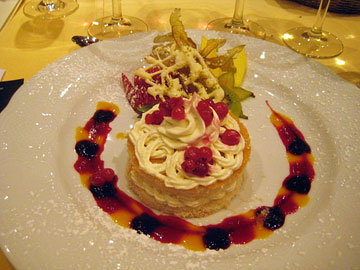
Mascarpone fairy cake


Dr. Peter Crusius
Wednesday, March 7: After breakfast we drive to Weingut Dr. Crusius in Traisen half an hour away. Peter Crusius owns 18 hectares. He made an interesting comment: “Berries are only there to nourish the seeds.”
- 2009 Dr. Crusius Black Dog Rotwein trocken (Pinot Noir and Frühburgunder): light ruby colour; floral, raspberry; easy drinking, dry, quite high in alcohol (86)
- 2011 Dr. Crusius Traiser Weissburgunder trocken: pale colour; minerally, peach pit nose with a light floral note; light and fresh, clean white peach and citrus flavour. Well made (88)
- 2010 Dr. Crusius Traiser Weissburgunder & Auxerrois trocken: minerally, peach pit, peach blossom; dry, spicy note, peach, light spritz; soft mouth feel (87)
- 2010 Dr. Crusius Norheimer Kirschheck Riesling Trocken: minerally, elderberry nose; dry, grapefruit flavour, clean, well made. Fine mouth feel (88)
- 2010 Dr. Crusius Rotenfels Riesling Trocken Grosses Gewächs: minerally-floral, Meyer lemon, peach; very elegant, lovely mouth feel, fresh and lively on the palate; good length (91)
- 2010 Dr. Crusius Bastei Riesling trocken Grosses Gewächs: minerally-floral, citrus; broader citrus grapefruit peel and apple flavours; touch of oxidation on the finish (88)
- 2010 Traiser Rotenfels Riesling Spätlese: deeper colour; spicy, honeyed peach, citrus; sweet Meyer lemon and white peach flavour, lovely tension between sweetness and citrus acidity. Great length, dances on the palate (92)
- 2010 Norheimer Kirschheck Riesling Auslese: medium straw colour; minerally, honeyed apple, botrytis note; rich, spicy, mango and peach flavours with lively acidity, long fresh finish. Great balance of sweetness and acidity (92)
- 2009 Dr. Crusius Traiser Riesling Eiswein: medium straw; spicy, honey, tropical fruit; rich and thick on the palate, mango, grapefruit and honey flavours; finishes beautifully light and balanced (93)

Dr. Crusius Traiser Riesling Eiswein 2009
I gave Peter Crusius a 200 mL bottle of Mike Weir Red Icewine 2008 and he surprised me with a bottle of his Traiser Riesling Eiswein 2009.
A 45-minute drive to the Rheingau region to visit Kloster Eberbach, a former Cistercian monastery founded in 1136. In the fifteenth century the monks controlled 10,000 hectares, 300 of which were under vine. In the tasting room above the new cellar we were offered a glass of Kloster Eberbach Riesling Brut. Took a photo of the gate that opens onto the Steinberg Vineyard that is enclosed behind a three-kilometer wall. Kloster Eberbach owns 220 hectares of vineyards, making them the largest holding in Germany – since the fifteenth century.

Kloster Eberbach

Gate to the Steinberg Vineyard
Lunch in the restaurant: Schaumsüppechen von Sauerampfer und Riesling mit Buttercroutons (a soup of bitter greens), served with 2008 Rüdesheimer Berg Schlossberg Riesling Trocken Erstes Gewächs. Filetmedallions vom Rheingauer Jungschwein (suckling pig) mit glaciertem Apfel und Calvaosrahm, bunte Rübchen und ofenfrischer Kartoffelstrudel, with 2009 Erbacher Marcobrunn Riesling Trocken Erstes Gewächs.


1959 Steinberger Cabinet Riesling Edelebeerenauslese
After lunch we are toured around the monastery and shown the bedroom where 120 monks slept. It was freezing but in their day there wasn’t even glass in the windows, so the average lifespan of a monk was 30 years. In the wine cellar there are over 30,000 bottles, the oldest of which dates back to 1706. We taste a Steinberger Cabinet Edelbeerenauslese 1959, which is amazingly fresh.
Then we take the bus to Eltville-Hattenheim to visit Weingut Balthasar Ress, stopping first at Stephan Ress’ Winebank. This is an off-site wine storage system for members, accessible only by credit card.

Stefan Ress with the "key" to the Winebank
The Winebank is situated in old cellars with a variety of cubicles ranging in size from lockers that hold two dozen bottles to full cellars holding 1,500 bottles and more. There are 230 units with a total capacity of 33,000 bottles. The smallest unit costs 36 euros a month. Members pay no corkage at local restaurants and have 24-hour access. There’s enough space to party down here. Stephan Ress greets us with a glass of Balthasar Ress Blanc de Noir 2010 sparkling Pinot Noir. Then into the old property for our tasting in a room that smells of smoke from the fires.
- Balthazar Ress “Von Unserm” Rheingau Riesling trocken 2010: minerally, grapefruit rind nose; dry, clean, lemony with a brittle finish (86)
- Balthazar Ress Rüdesheim Berg Schlossberg Riesling Trocken 2010: minerally, iodine nose; light, crisply dry, grapefruit and lime flavours (87)
- Balthazar Ress Rüdesheim Berg Schlossberg Riesling Trocken 2008: minerally, petrol and tar notes; grapefruit with a honeyed notes; light on the palate with a crisp acidic finish (88)
- Balthazar Ress Schloss Reichartshausen Riesling Kabinett 2010: minerally, lemon peel; elegant, beautifully balanced, peach and citrus flavours; long fresh finish (89)
- Balthazar Ress Hattenheim Nussbrunnen Riesling Spätlese 2009: yellow straw colour; developing petrol notes, dried apricot; rich, spicy, peach and honey flavours, sweetness balanced by citrus acidity (89)
- Balthazar Ress Hattenheim Nussbrunnen Riesling Spätlese 2007: minerally, oily, honey; quite dry for a Spätlese, clean and light, lovely mouth feel with good length and balance (89)
- Balthazar Ress Hattenheim Nussbrunnen Riesling Auslese 2001: deep colour; rich, dried apricot and honeyed nose; elegant, dried stone fruits with lively acidity giving the wine great length (90)
- Balthazar Ress Hattenheim Nussbrunnen Riesling Auslese 1989: deep amber colour; intense marmalade and barley sugar nose; drying out but still aristocratic with dried apricot, honey and woody notes (90)
- Balthazar Ress Hattenheim Nussbrunnen Riesling Beerenauslese 2006: light amber colour; toffee, orange peel nose; sweet molasses and citrus flavours with a long toffee finish (91)
- Balthazar Ress Hattenheim Nussbrunnen Riesling Trockenbeerenauslese 2002: amber colour; ripe, honey, dried apricot nose with botrytis notes; sweet and unctuous but not treacly, very light on the palate with tangerine acidity and great length (93)
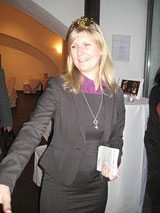
Rheingau's Wine Queen Elena Benischke
At the end of the tasting Stephan Ress tells us about his latest venture. He has planted one-third of a hectare on the island of Sylt, situated on latitude 55°, the most northerly part of Germany. Sylt, a very fashionable vacation island for the rich near Jutland, is connected to the mainland by a rail link which transports in cars. Stephan has planted Müller-Thurgau and Solaris here and has presold one-third of the vines to wine lovers – for which they will receive a bottle of wine a year.
Our next stop is within walking distance – Weingut Georg Müller-Stiftung. I had visited the facility four years ago and had brought back home their Pinot Noir, which I enjoyed very much. Here we are greeted by Elena Benischke, Rheingau’s Wine Queen, a title she holds for a year. The estate was founded in 1882 by Georg Müller, who died without heirs and left the 6-hectare property to the town of Hattenheim in 1913, stipulating that the profits go to the needy of the community . The estate was allowed to run down over the years and in 2003 it was purchased by Peter Winter, an art lover who commissioned works for the cellar. Some thirty-odd contemporary works and installations permanently grace the cellar with a changing exhibition on the walls upstairs.

Sculpture in Georg Müller cellar

Art installation in Georg Müller cellar
We begin with a tasting in the cellar accompanied by hors d’oeuvres, conducted by the estate manager, Alf Ewald: Georg Müller Riesling Kabinett trocken 2011 with Black Forest ham on leaven bread, Georg Müller Hattenheimer Schüzenhaus Riesling Kabinett 2011 with beetroot salad with potatoes and Rheingau apples and Georg Müller Edition PW Spätburgunder Trocken 2008. Then upstairs to sit down for dinner! Braised beef from the Taunus Mountains with mushed (sic) potatoes and root vegetables, with Georg Müller Daniel Spätburgunder Trocken 2009 (named for Peter Winter’s son), followed by baked apple with redcurrants from the Rheingau with light custard, served with Georg Müller Katharina Riesling Auslese 2007 (named for his daughter).
Our bus to the hotel can’t negotiate Eltville-Hattenheim’s narrow streets and we have to walk about 500 meters in the pouring rain to where it is parked. We drive to Hotel Tillmans, which is locked when we arrive, and we wait outside until the owner eventually comes down to open the door and then gives us a lecture worthy of a PhD seminar on how to use the room keys.
Thursday, March 8: Our last day in Germany. After breakfast we drive to Domdechant Werner’sches Weingut in Hochheim am Main. Dr. Franz Werner Michel tells us that one of his descendants printed the original Communist Manifesto. He was a fellow traveller who eventually lost faith in Communism and became Mayor of Mainz. Dr. Michel, emulating his forebear, says, “I always start our tastings on the left and end on the right.”
- Domdechant Werner 2011 Hochheimer Hölle Riesling Kabinett Trocken: medium straw colour; minerally, peach nose; racy, lime and peach flavour (87)
- Domdechant Werner 2010 Hochheimer Kirschenstück Spätlese Trocken: very pale; floral, minerally, citrus; fresh and lively, crisp, lime and white peach flavours; mouth-watering (88)
- Domdechant Werner 2009 Domdechaney Hochheim Riesling Erstes Gewächs: straw-lime colour; apple, honeyed note with a mineral thread; elegant, off-dry, floral-honey and peach flavours, lovely balance, firm finish. Carries its 14% alcohol very well (90)
- Domdechant Werner 2010 Domdechaney Hocheim Riesling Erstes Gewächs: straw with a lime tint; minerally, honey, floral note; leaner and more acidic that the 2009; racy, lime (88)
- Domdechant Werner 2011 Hochheimer Hölle Riesling Kabinett: pale straw with a green tint; apple, floral, honeyed note; off-dry, honeyed apple, fine strain of acidity (89+)
- Domdechant Werner 2011 Hochheimer Hölle Riesling Spätlese: straw-lime colour; spicy-fruity, mineral nose; broad, peach and apricot, honey flavours; soft mouth feel, a touch of bitterness on the finish (89)
- Domdechant Werner 2011 Hochheimer Domdechaney Riesling Auslese: pale colour; minerally, honey, high toned, apple; honeyed peach flavour, nicely balanced but marred by a hard, bitter note on the finish. Needs time (88+)
- Domdechant Werner 2006 Hochheimer Domdechaney Riesling Auslese: gold with a lime tint; high toned, honey, raisiny, peach; rich, mouth-filling, dried apricot and honey; a touch hard on the finish (89)
- Domdechant Werner 2002 Hochheimer Domdechaney Riesling Auslese: light amber colour; honey, petrol, high toned, barley sugar nose; lively acidity, orange, apricot and honey; quite dry for an Auslese (89)
We walk around the corner to the Restaurant Hochheimer Hof, where we are told we can order what we like. I have a Bavarian beer and a plate of ox tongue with rösti potatoes and root vegetables, followed by a glass of anonymous Pinot Noir. The group leaves from the restaurant for Frankfurt Airport and the flight home.
Friday, March 9: Up at 5:30 am courtesy of The Wonder Dog, who wants to go out. A Vintages release tasting this morning and then a memorial service for my friend David Wesson in the afternoon. Dinner, tilapia wrapped in prosciutto with a parsley, mint and pint nut stuffing with a bottle of Savion Muscadet 2010.